Here at GroupSolver, we’re intrigued by the choices people make, especially the everyday ones that seem simple on the surface but tell a deeper story underneath. To some, these are mundane, routine decisions. But to us, they reveal much more about the world we live in.
Take chicken and backpacks. One is a dinner staple, the other an item we toss over our shoulder without thinking twice. But when we dug into how people choose between different versions of each, we uncovered some surprising insights about our values, tradeoffs, and what the “Made in USA” label is really worth to us.
So, we ran a discrete choice experiment with 214 respondents, each making four decisions for both categories resulting in about 800 product comparisons for chicken and backpacks. Analyzing what choices people made from each pair options, we can begin to understand what it is about those products that customers are willing to pay for.
What we found: country of origin matters, but not always in the ways you’d expect.
The Power and Limitations of Product Origin
Let’s start with what was loud and clear: “Imported from China” and “Imported from Mexico” both had a strong negative effect on likelihood to purchase. Whether it’s due to political sentiment or simple concerns over quality (or a mix of both), people don’t respond well to these labels. For retailers, this means one thing: if origin isn’t a selling point, it’s probably best to keep it low profile.
But just slapping “Made in USA” on a product doesn’t guarantee success either. The more specific and comprehensive the claim, the better:
For chicken, “Raised and processed in USA” had more pull than a generic origin statement.
For backpacks, the strongest claim was “Designed and made in USA using American-produced materials.”
It turns out that shoppers don’t just want the feel-good label, they want the whole story: they want to know how the product was conceived, crafted, and built in the USA. When Origin Isn’t the Biggest Deal
Brands need to remember that it isn’t just _about where the product is from. In some cases, other claims outshine the origin story altogether.
For chicken, consumers were more swayed by health-related claims. “No antibiotics ever” was a top driver of choice, while price and type of meat (chicken breast being the clear favorite) were also major influencers…and fresh chicken won out over frozen every time. For backpacks, social and environmental responsibility took the spotlight. Claims that the product was: - Made from recycled materials, - From a family-owned business, - Profits supported causes like DEI or education These types of product attributes had as much or even more impact than where the bag was made and gave consumers a sense of purpose in their purchase, especially in a category where values and self-expression matter. To us, this reveals that we fundamentally care about the impact of our purchases across multiple dimensions.
What’s the Price Tag on “Made in USA”?
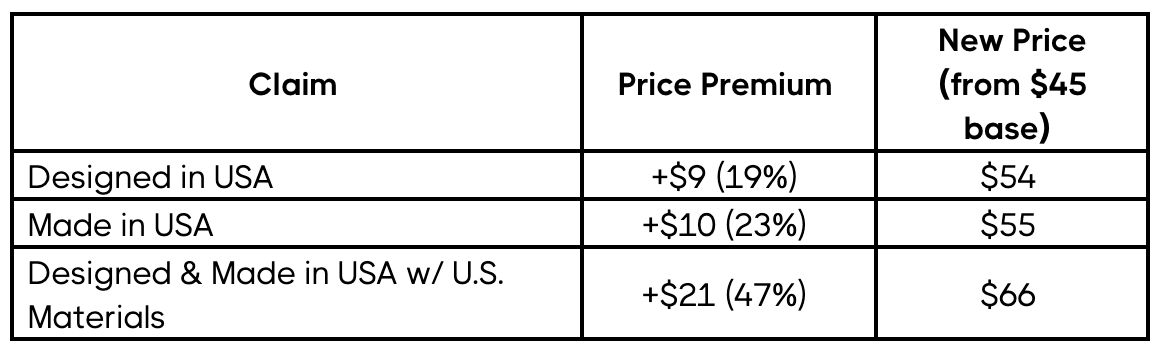
Next, we dug into the data to estimate just how much more people are willing to pay for domestic production. Or in other words, how “worth it” these products are to consumers.Chicken:- A fresh chicken breast at Walmart runs around $3.15/lb. - Our simulator suggests that labeling it “Raised and Processed in USA” (our strongest-performing origin claim, though not statistically significant) might support a $1.20/lb premium. - Even adding a 10% tariff on Brazilian imports, the cost gap leaves only a $1.33 cushion for U.S. producers– slim margins when you factor in higher labor costs and potential for no-antibiotic production.Backpacks:_
We saw a clearer willingness to pay in this category:
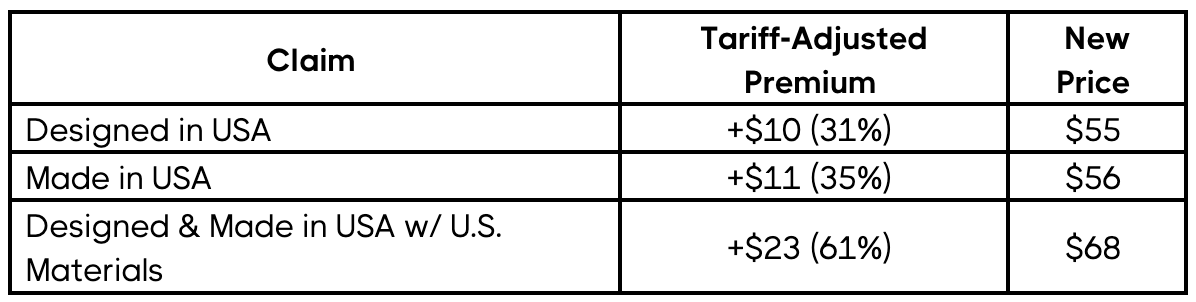
Adding a modest 10% tariff on Chinese imports made those premiums even stronger:
 But here’s the catch: when we compared against backpacks made from recycled materials abroad, the premium shrinks:
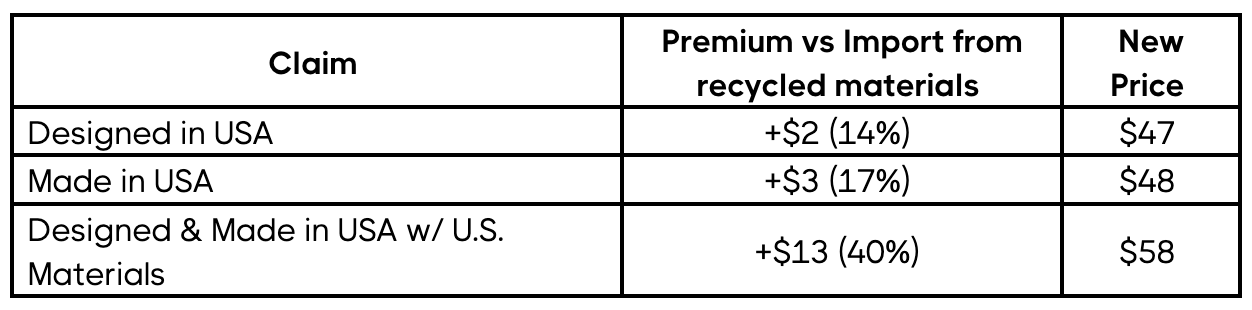 An eco-conscious imported backpack becomes a strong competitor: proof that sustainability can level the playing field or even tip the scales.
What We Took Away
So, how can we digest all of this? Here are a few big takeaways from this not-so-simple comparison of chicken and backpacks:
Consumers dislike “Imported from…” labels, especially from countries that raise red flags in public perception.
“Made in USA” has value, but only when it’s detailed. The more of the supply chain is domestic, the more consumers are willing to pay for the product.
Values and health trump origin in some cases. For chicken, avoiding antibiotics was more influential than where it was raised. For backpacks, sustainability and social causes held real weight.
Price is always in the driver’s seat. People might say they value domestic production, but when it’s time to buy, many still go with the better deal.
There’s no silver bullet. Tariffs help a little. Labels help some. But consumers weigh multiple factors; origin is just one piece of a bigger picture.
Our study reminded us that purchasing decisions are rarely straightforward. They’re a mix of practical needs, personal values, and social context. And while “Made in USA” still resonates, it has to ultimately compete with other messages such as health, sustainability, and price.
If you’re a brand looking to win with modern consumers, the takeaway is clear: tell a complete story, not just a patriotic one.