As it is for most businesses, maximizing profits is probably one of your biggest goals. Being able to segment your audience by identifying their individual characteristics, purchasing habits, and more is a crucial step in doing so. An effectual way to ensure that you are checking this box is by creating customer personas.
What is a Customer Persona?
A customer persona is an ideal individual that represents the characteristics of a particular segment of your target market. This includes personality, interests, preferences, and goals among other things. Creating these personas is a sure-fire way for you to get a better picture of the type of people that you are selling to, and as a result makes it easier to customize your business methods to better fit their needs.
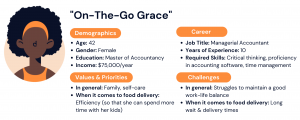
Below is an example of what a customer persona might look like for a business in the food delivery industry.
Why Are Customer Personas Important?
Refreshing your segmentation strategy is always a worthwhile venture for the success of your business, and there are three main reasons why creating buyer personas may be the right choice to help you set that process in motion.
1. Narrows Your Strategy
If you use the same marketing tactics for all your segments, there is a big chance that you are wasting valuable time and resources advertising to people who are not interested in buying your product or service. Customer personas can help you to tailor your strategy to each individual segment.
2. Helps Raise Conversion
Customer personas can teach you what types of language will inspire your customer, what modes of communication they prefer, what elements of your product or service would help them the most, and much more. Possessing this knowledge can often be the difference between a lost lead and a converted customer.
3. Cultivates a Client-Focused Environment
Recognizing that your clients have specific needs that must be addressed allows you to be certain that you are showing off the features of your product or service that will benefit them most.
How to Create a Customer Persona
Sending out a survey is an efficient and effective way to collect information on your customers. Likewise, they are a useful tool for creating buyer personas as they allow you to gather information from multiple groups of people within your target market. Follow these 5 steps to start building your customer personas using survey best practices.
Step 1: Identify Your Segments
The first step of this process is to identify your customer segments
. These segments are groups that exist within your general target audience that share similar characteristics. Each of these segments will serve as an overarching outline for a particular customer persona.
Step 2: Decide Which Customer Segments to Survey
Now that you have identified some broad categories of customers that you have, you can decide which ones you want to focus on creating a persona for. The data from the survey will help you further refine these categories and personas later on, but you’ll need to start somewhere initially. With a survey, you also always have the option to launch multiple studies–so you can tackle multiple segments simultaneously.
Step 3: Design Your Customer Persona Survey Questions
The next step of the process will be to design your survey. You will want to ask questions about multiple categories of their life and behavior– This may include their general demographics, career aspirations, buying habits, and anything else that could help you to create a persona that is representative of the segment you chose.
In the next section, we have curated a list of categories and questions that will be useful to include in your survey. Some of these examples may also double as screener questions
to ensure you reach the right audience to survey in the first place.
Personal Questions
To start out your survey, you will want to ask questions that will paint you a basic picture of the respondent. Asking demographic (“about you”) questions will not only help you achieve this, but it will also allow you to identify the most common characteristics within the customer segment and construct a persona that encompasses them. Listed below are some of the most common demographic questions:
- What is your age?
- What is your annual household income?
- What is your highest obtained level of education?
- With what gender do you identify?
- What is your ethnicity?
Another category of personal questions to touch on in your study is a person’s hobbies and day-to-day activities. These answers can help you to get to know the user on a deeper level and can be indicative of the type of person they are. For this type of question, consider using an open-ended format to allow for the most candid, individualized answers.
- What is your favorite activity to do outside of work?
- Do you have any hobbies? If so, what are they?
Career Questions
A person’s career often occupies a significant part of their life, which is why getting an idea of what their work life looks like can help to build a more accurate profile. Here are a couple of questions you could ask related to careers:
- In what industry do you work?
- What is your job title?
- What types of skills must you possess to succeed in your position?
Challenges
Asking users directly about the hurdles or inconveniences that they face on a day-to-day basis (could be personal, work-related, or both depending on your product or service offering) is the easiest way to determine where your product or service can fit into their lifestyle. Below are a few examples of questions you could ask users related to their challenges.
- What is the #1 daily challenge that you face in your [personal/professional] life?
- How does this challenge make you feel?
NOTE: It may be beneficial to tailor these questions to relate more to the industry in which your product/service belongs. For example, if you own a food delivery business, you could ask “What is the #1 challenge that you face when going through the food delivery process?”
Values
A person’s values serve as a road map to the decisions they make, habits they practice, and the version of themselves that they choose to present to the world. Asking questions relating to users’ values can help you to determine what is important to that segment of customers, and how your product or service can align with those areas. Listed below are a few questions you can ask to uncover consumer values.
In no particular order, what areas do you value most in life?
- a. Family
- b. Marriage, romantic relationships
- c. Friendship
- d. Professional life
- e. Academic life
- f. Leisure and recreation
- g. Spirituality or religion
- h. Citizenship
- i. Self-care
- j. Other
Do you believe that your career aligns with your values?
- If yes, how so?
- If no, why not?
Step 4: Send out your Survey
Choosing a platform that meets all of your research needs can be overwhelming. You want a service that gets the job done quickly and efficiently, but also one that will give you high-quality, actionable results. So how do you know which one is right for you?
When you use a survey platform like GroupSolver, creating and distributing your customer persona survey and analyzing the results will feel like a breeze. The unique, AI-powered technology can turn answers to open-ended questions into quantifiable data, which can help you to easily select answers for your personas that most accurately represent the whole. Find out more and jumpstart your customer persona survey by requesting a GroupSolver demo today.
Step 5: Translate Survey Data into Profiles
Once your data has been collected, it is now time to create your customer persona. Depending on how many segments you split your audience into or surveys you distributed, you may have a few more personas to create. By evaluating the patterns and common answers to each question, you can extract the most popular themes (or the answers that you believe to be most representative of that segment) and combine them all into one imaginary person.
For example, if the majority of your respondents within a particular segment said that they were females between the ages of 25-30 and work in marketing, that will be a broad profile of your persona.
Elevate Your Segmentation Strategy with Customer Personas
Now that you’ve built your personas, you are free to use them as a reference for any and all aspects of your business- to refine your sales strategy, build a closer relationship with your customers, or adjust your product or service to better fit their needs. The possibilities are endless!
If you are ready to jump-start your customer persona journey with GroupSolver, we are here to help. Click here
to chat with one of our team members.