


Which story on the US economy will the undecided voter buy: Biden’s or Trump’s?
Back at the end of January, we surveyed voters in Michigan and asked them about the most important issues on top of their minds as we are heading into this election year. From their responses it became clear that the economy is at the front and center of their attention. It stands to reason that the presidential candidate who tells the more believable story to the undecided voter may have the decisive edge on November 5th.
To better understand how voters think about those winning stories, we headed to Georgia, another swing state. Here we talked to 183 likely voters across the political spectrum. We were curious about their thoughts on the key issues that are impacting their choice for the President, and whether they were on the same page as Michigan voters. We also asked them to help us tell the story they wish their preferred presidential candidate told the nation before the election to convince the undecided voters to vote for their candidate.
Here is what they said…
The economy stands in the forefront across the board.
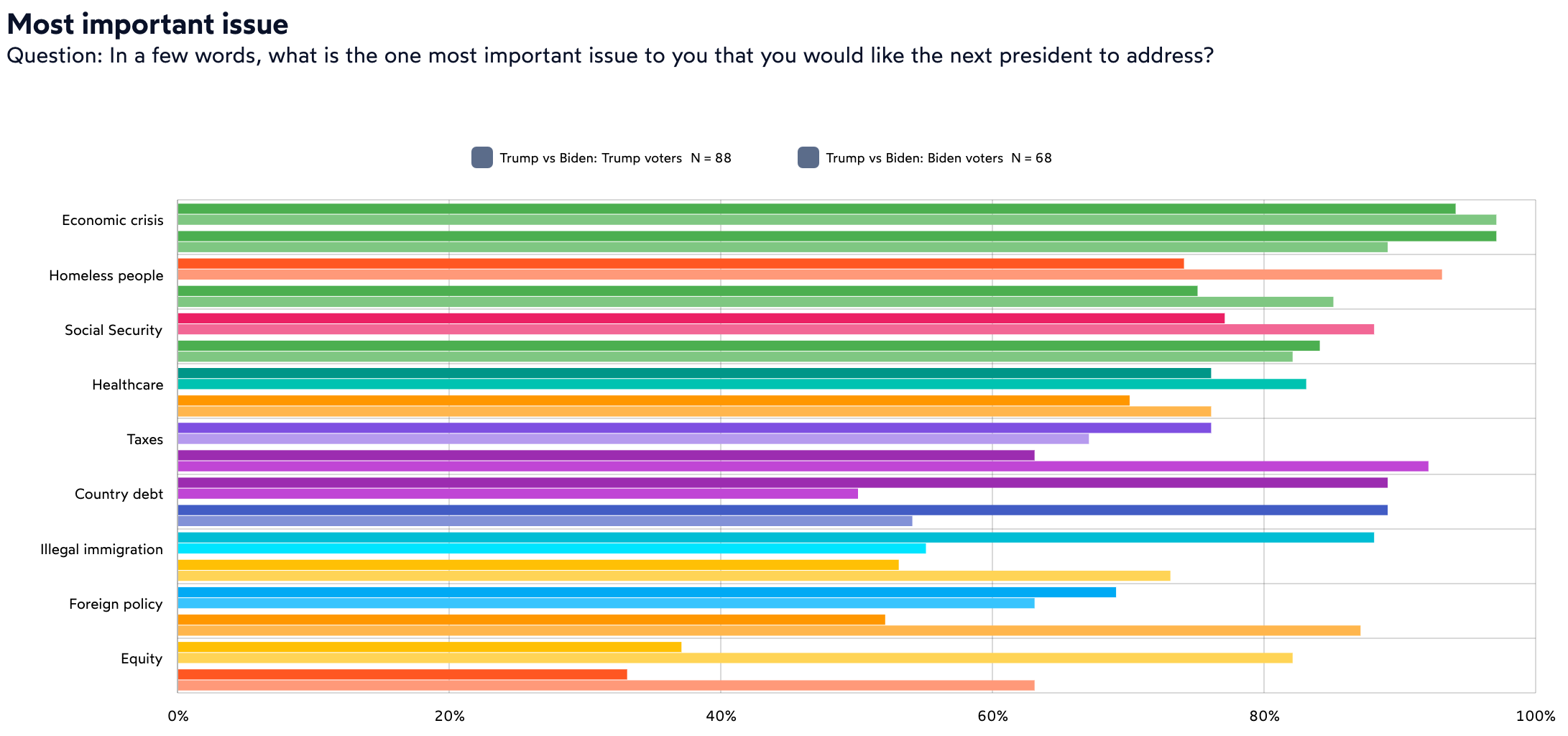
Similar to our Michigan study, economic issues continue to top the list of concerns – both for Trump and for Biden voters. However, there are important differences in what Biden and Trump voters want to be addressed by the next president.
Trump voters care significantly more about taxes and the country’s debt, and they strongly worry about illegal immigration and border security. Democrats, on the other hand, are more concerned about social issues such as homelessness, equity, abortion, climate change, gun control, etc. Biden voters also put social security and minimum wage high on their list of concerns, straddling the areas of economic and social concerns.
With the economic issues topping the list as expected, we asked our survey respondents, likely voters in Georgia, to think about the most compelling story their preferred candidate should tell the nation to convince it to vote for him.
What we present below are very lightly edited statements made by actual human respondents with the aid of AI algorithm to help them build a consensus story that would resonate with their peers. Generative AI did not create any statements that are part of the story, this narrative was crowdsourced in its entirety by the voters in Georgia. To review the raw survey data, we invite you to follow these links to the Trump’s and Biden’s story. In this data, you will be able to not only see the unedited statements made by our respondents, but also their statistics that show the strength of their consensus agreement.
The stories are, as you might expect, not perfectly crafted in a way a speech writer might compose them. But with their imperfections, they are revealing the main theses those two candidates may want to incorporate in their messaging to resonate with their voters. As you are reading these stories, we encourage you to keep in mind that you are reading voices of dozens of regular people tuning in a consensus voice. People like you and me.
Trump’s story on the economy as told by eighty-eight likely voters in Georgia who would vote for Donald Trump today.
“In the years that Joe Biden has been president the cost of living has risen substantially and the economy declined during Biden years. Joe Biden destroyed the progress we made as a nation, it’s hurting our economy.
I have plans to recover from it. I have done that before, and I will make it happen again. My focus will be on building the economy back up again. It is in crisis right now, but I can bring us back. Look how the economy was under me, do you want that again? Our economy will continue to get stronger. We had the best economy under me, and it will be even better than in my last term. Our economy was doing very well during Trump administration, it was booming, and the jobs were flowing in. We were in a great shape.
Interest rates were lower than they are now. I was able to hold them down. When I was the President, people were able to buy homes affordably, people could buy groceries.
I will cut interest rates on homes. I will open our natural resources for Americans. We are going to get the pipeline back up and running. Let’s continue to make America great.
I will bring jobs back to this country, including the oil industry, and will encourage oil production in the U.S. I will be working diligently to increase jobs availability, lower unemployment and will help increase job opportunities and the chances of Americans with jobs. I will increase wages and everyone will get a stimulus check again.
I will tackle inflation and will bring it down dramatically, including the gas prices. Because the future of our economy depends on lowering inflation. Look how the economy was under me, do you want to continue to pay high prices for everything? I promise you to make all prices go back down. The cost of living will decrease so that people can live comfortably in their own home.
And I will solve the immigration problem and our border crisis. We will secure our border to ensure a turnaround. We will close the Mexican border, illegals will be deported now.”
While the story was written from elements sourced independently from individuals who shared their thoughts with us, it is easy to pick up main themes: Trump will bring back the good days from before COVID and Biden, he will bring back order and prosperity that are lacking today. These themes are consistent with how Trump voters see the economy today: it is lagging and in a bad shape, and it is likely to not improve if it continues on its current trajectory.
Biden’s story on the economy as told by sixty-eight likely Georgia voters who would vote for Biden today.
“I have been working hard to fix our economy. It has been improving and it will continue to improve. It is a lot better than it was in the not so far distance. And it will continue to get better. Our economic system will run better under my leadership than under Trump. I have proven that I can lower inflation.
We are still seeing the effects of Donald Trump’s declining economy, but I have reversed the poor economic situation after the Trump fiasco.
Inflation has been down and you will continue to see it dropping. It has dropped steadily over the last two years, as has unemployment. Just compare what the inflation level was three years ago. Our low unemployment rate is still dropping.
But inflation is still on the table. The gas prices are amazingly low now, but the cost to eat is almost not doable. This is a work in progress. We need to change things obviously and that change is on the way.
Let me finish what we started. I was by your side during COVID and I will stay by your side. I am going to fight tooth and nail for this nation, let us finish strong! We have come this far, let us continue to improve this country. We are moving forward to improve the nation. We will spend money on improving American domestic concerns than overseas interests. And when we do address overseas issues, I understand the diplomacy and how to deal with issues.
I am focused on raising the minimum wage and will continue to create jobs. I will increase the federally mandated minimum wage to levels equal to the increase in living costs.”
Biden voters want him to remind the nation how much the economy has improved since COVID and the last president. They see Biden as a hard worker who will stand with the nation until the fight is done. Similar to how they view the economic data, they see positives achieved already and expect the trend to continue to improve… all the while recognizing that there is more work left to do.
Both Biden and Trump stories showcase a big difference in how voters see the economy today. One is looking to bring back the good times, the other sees the change for the better as having already happened and wants to continue the trajectory until the fight is done. But what about those voters who have not yet decided which of these two stories they want to get onboard with? How do they see the economy?
Story of the U.S. economy as told by 27 likely voters from Georgia who would vote neither for Biden nor Trump.
“While the US Economy is showing signs of recovery with strong job growth, unemployment is still here. While the unemployment rate has flattened out, there are still people out there in need of money. Those low unemployment government jobs do not create products at all. Part of the problem is that it is hard to find suitable employment. We need more job openings available. I believe that AI is reducing employment.
Inflation is still high. Groceries are much higher than 3 years ago as is gas. Prices of everyday goods have soared. It is really a big issue now, it is severely affecting us. People are hurting here while our government is funding a war in Ukraine.
Economy is not doing well, it is not well balanced, between both wars and conflict. It is in a vitally bad situation because of government overreach. The economic shutdown during COVID was crippling. The economy is heading downhill, we are on the wrong track, I can see it surely declining. I feel like we are heading toward recession.
I am worried about the impending housing crisis. Housing prices are very high. And the wages are stagnant and not offsetting price increases. Salaries have not been adjusted to inflation, so people are struggling to make a living. Life is a battle.
It is particularly hard for the elderly and the middle class. Social security is not keeping up with the times and without retirement savings, you are quickly in the red. Inflation is killing the working class, it is disappearing. We are becoming either very rich or very poor. The gap has widened between low-income and high-income Americans. It will be difficult for many families to have what they need. The average working family is having a difficult time financially.”
In their story, the undecided voters are not saying they want to go back to “before COVID and Biden” but at the same time, they do not see the trajectory forward as a straight forward path to a better future. They have not yet embraced Biden’s or Trump’s story. What they see today is high prices and not being able to find jobs that pay enough to offset them and put them ahead. They are not participating in the prosperity some may see, but they are also not identifying Donald Trump’s tenure as the place to get back to. They are caught in the thick of the recession, perhaps stuck in that growing income inequality gap they have identified in their story. Neither story is appealing to them right now, but they are planning on voting in November and perhaps they can be convinced.
Now that our respondents in Michigan and Georgia helped us craft their candidates’ winning stories on the economy, it is time to test them. In our next study, we will test these crowdsourced stories with independent voters in other swing states and see where they land. Do they have the power to convince the undecided voter? Stay tuned!
Share this article


You might enjoy these too





 Back
Back

