
AI Open-End™
Open-ended answers,
quantified by the crowd.
AI Open-End™ replaces the free-text box with a guided process where respondents contribute, evaluate, and converge on consensus. The result is ranked, quantified themes you can chart, segment, and download — without coding a single verbatim.
No deck, no pitch, just the platform answering your questions.
0
manual coding required to publish results
Ranked
themes with agreement scores out of the box
Live
consensus emerges as fieldwork progresses
Segment-able
by any quant variable in the same study
How it works
Three phases turn raw text into ranked themes
Each respondent isn't just answering — they're contributing to a collaborative process that scores ideas while the study is live. No analyst coding step, no post-fielding delay.
Ideation
Every respondent contributes their answer in their own words — no options to anchor them, no other answers visible. You get the spontaneous, unbiased input a traditional open-end was supposed to deliver.
Elaboration
Later respondents see what others said and react — agree, disagree, mark as unclear. Individual opinion becomes collective signal, with statistical confidence on every statement.
Idea matching & themes
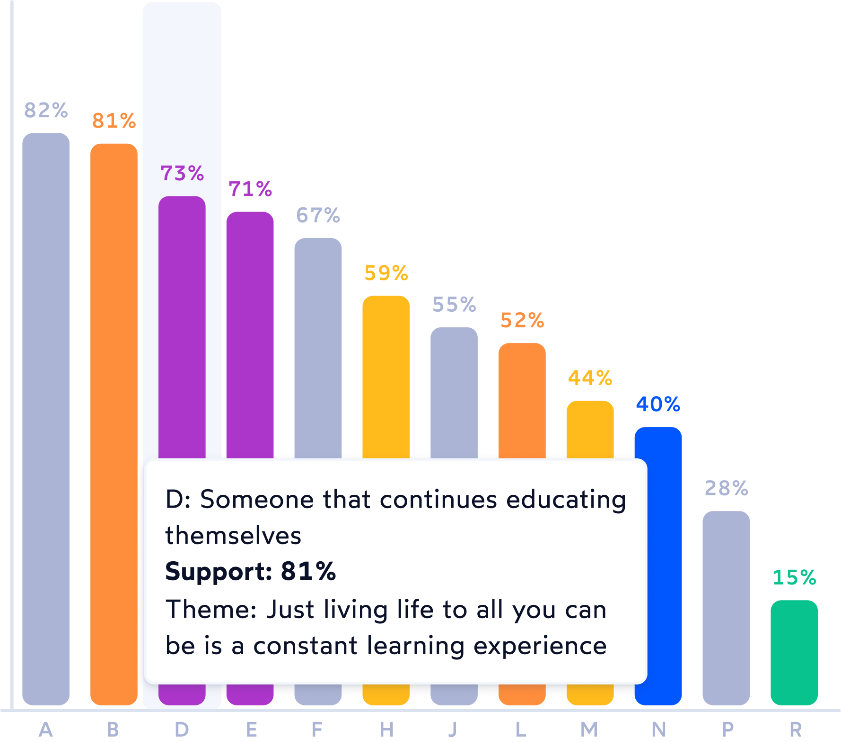
Similar statements are grouped into themes ranked by support. The output is ready to chart, segment, or drop into a LiveSlide — while the study is still in field.
Capabilities
Everything you'd build manually, already built in
Ranked themes, automatically
Verbatims are clustered into themes ranked by support, with agreement, disagreement and neutral scores on every statement. No coding lists, no inter-coder reliability.
IdeaCloud™ visualization
A weighted view of every theme, sized by support and clustered by similarity. Presentation-ready output that communicates consensus and divergence at a glance.
Chart-native output
Drop an AI Open-End chart into any report or LiveSlide. Switch between support and response-count views, show themes plus top unthemed answers, all without rebuilding the chart.
Cut by any segment
Every theme can be re-scored against any segment defined in the same study. See which audiences agree with which ideas — not just what was said overall.
Follow-up probing
Add a follow-up question targeting a specific theme. Respondents who agreed with that idea get a deeper question — one level further — without running a separate study.
Custom idea-pool size
Control how many statements respondents evaluate. Keep it lean for early-stage exploration, or expand it for a major launch where depth matters and your sample can support it.
Pre-seeding
Inject statements you want evaluated from day one — competitor messages, hypotheses, regulatory claims — and let the crowd score them alongside their own ideas.
Verbatim & theme download
Export every verbatim with its theme, support scores, and respondent metadata. The same table format as the rest of the study, ready for SPSS or any analysis tool you use.
Live during fielding
Themes update as completes arrive. Watch consensus form during the field period and adjust quotas or stop early when the picture is clear.
Agatha AI
The AI does the coding so you can do the thinking.
AI Open-End is GroupSolver's flagship engine — a purpose-built model that clusters, ranks, and themes open-ended responses in real time. It's the foundation Agatha builds on for everything from cross-tab analysis to autonomous report generation.
See Agatha in actionReal-time theming
Statements are clustered into themes as the field period progresses — no batch process, no analyst hand-off. The picture sharpens as more respondents contribute.
AutoTheme suggestions
Agatha proposes theme names and groupings you can accept, edit, or override. Custom prompts are on the roadmap for full editorial control over how themes are described.
Powers Agatha analysis
Every downstream Agatha agent — cross-tabs, key segments, autonomous reports — draws on the same themed, quantified output. One model behind every insight.
Who it's for
When the question is too important for a multiple choice list
Brand strategists
What your brand actually means
Skip the pre-written list and let consumers describe your brand in their own words — at a scale where the language itself becomes a measurable input.
Concept testers
Why a concept wins or loses
Add an AI Open-End to any concept test to capture reasons-why at sample size. Ranked themes show what drove appeal — or killed it — alongside the quant score.
CX teams
NPS verbatims that actually mean something
Replace the comment box on NPS or CSAT with an AI Open-End and get ranked drivers of detraction and promotion — not a thousand unread snippets.
Innovation teams
Crowdsource the next idea
Use AI Open-End as a structured ideation tool. Pre-seed hypotheses, let employees or customers contribute and evaluate, and walk away with ranked priorities.
Public-affairs & policy
Comment periods at scale
Run consultative studies where citizens contribute and evaluate ideas. The output is auditable, ranked, and segment-able — defensible against accusations of cherry-picking.
Employee insights
Anonymous voice with statistical weight
Engagement scales tell you the score; AI Open-End surfaces the ranked reasons. Employees vote anonymously with their own words — consensus emerges without HR coding.
Why AI Open-End
Open-ends, finally usable at scale.
Traditional research treats open-ended responses as an expensive afterthought — coded by hand, analyzed days later, lost in the deck. AI Open-End makes them a first-class quant output.
Ready to see Agatha?
Book a 30-minute demo with our research team. No deck, no pitch, just the platform answering your questions.
Book a 30-min demoNo credit card · we reply within 24h