Solutions
Agatha Brand Perception Brand Equity Customer Segmentation Concept Testing Product Development Pricing Research Employee Experience All solutionsIndustries
Consumer Packaged Goods Food & Beverage Retail Healthcare Financial Services Technology All industriesPlatform
How it Works
See how Agatha turns survey data into decision-ready insights in minutes.
Features
Agatha AI
Coming soon · Your autonomous research analyst.
LiveSlides™
Live presentations that update as data comes in.
Solver Interface
The AI-powered respondent experience.
Libraries
Reusable question templates for faster study design.
QuantQual
Quant scale and qual depth — in one study.
MCP Server
Coming soon · Your studies, native in every AI tool.
AI Open-End™
Open-ended responses, quantified at scale.
Segments
Reusable audiences across the whole study.
Respondent Manager
Data-quality control for every study.
IdeaCloud™
Open-end verbatims, visualised by support strength.
HaloGraph™
Drill from themes to verbatims in one sunburst chart.
AugmentIQ™
Coming soon · Test your survey on AI respondents before launch.
Focus Groups
Live discussions and async bulletin boards.
Multilanguage
23 languages. One study. One dashboard.
Learn
Case Studies Real research, real results Blog Insights on market research FAQ Common questions answeredData Quality
Data Quality Reports Monthly evidence of research integrity Data Quality Our commitment to research integrity
Although the COVID-19 vaccines have shown safe and effective results, many people still have fear and doubt in them. Misinformation continues to fuel vaccine conspiracy theories and causing some to decline getting vaccinated. Our recent study looks at the latest feelings and opinions about the COVID-19 vaccines.
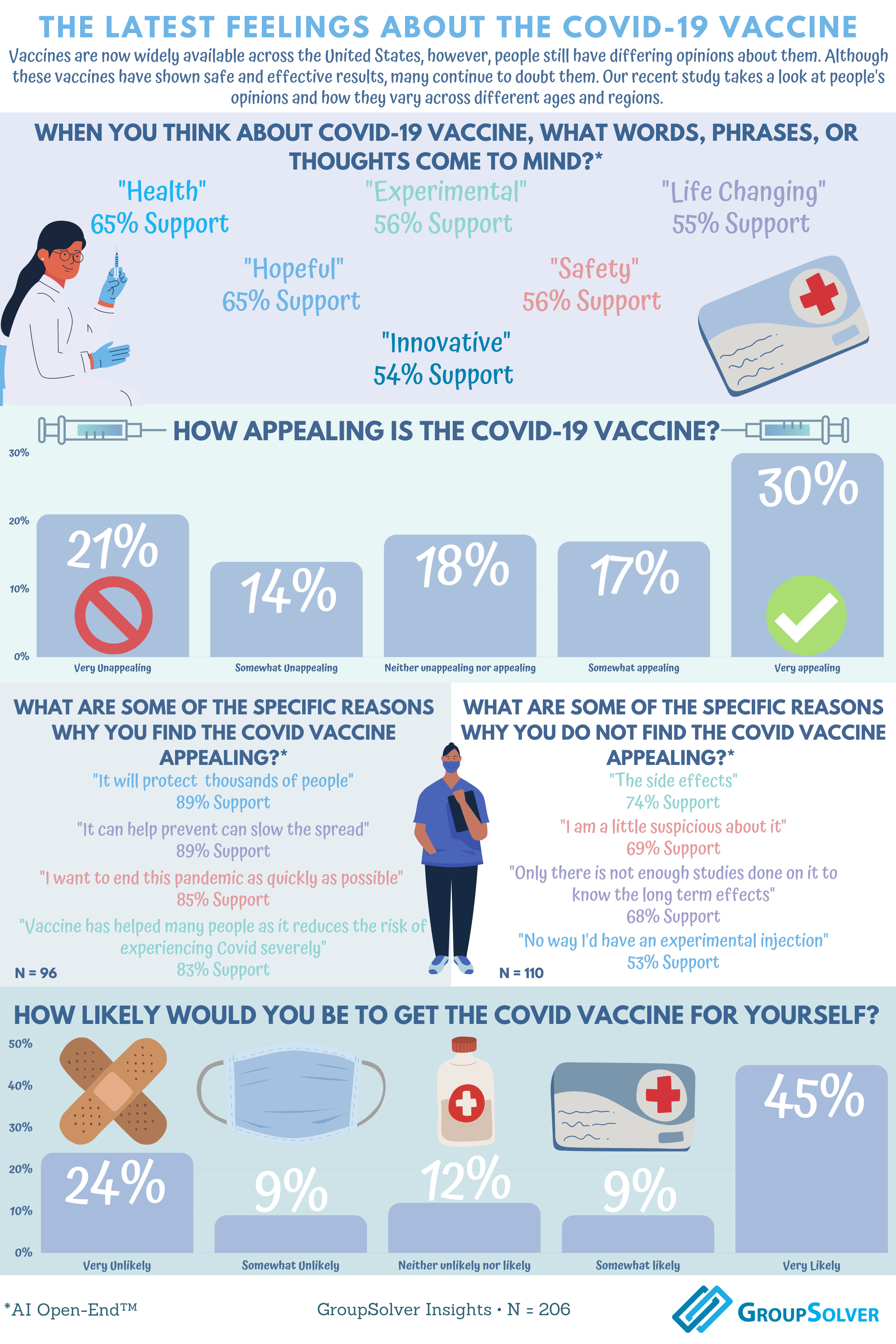
Those who find the vaccine appealing say that “It will protect thousands of people” (89%) and that the “Vaccine has helped many people as it reduces the risk of experiencing COVID severely” (83%). On the other hand, those who do not find the vaccine appealing feel “a little suspicious about it” (69%) and worry about “the side effects” (74%).
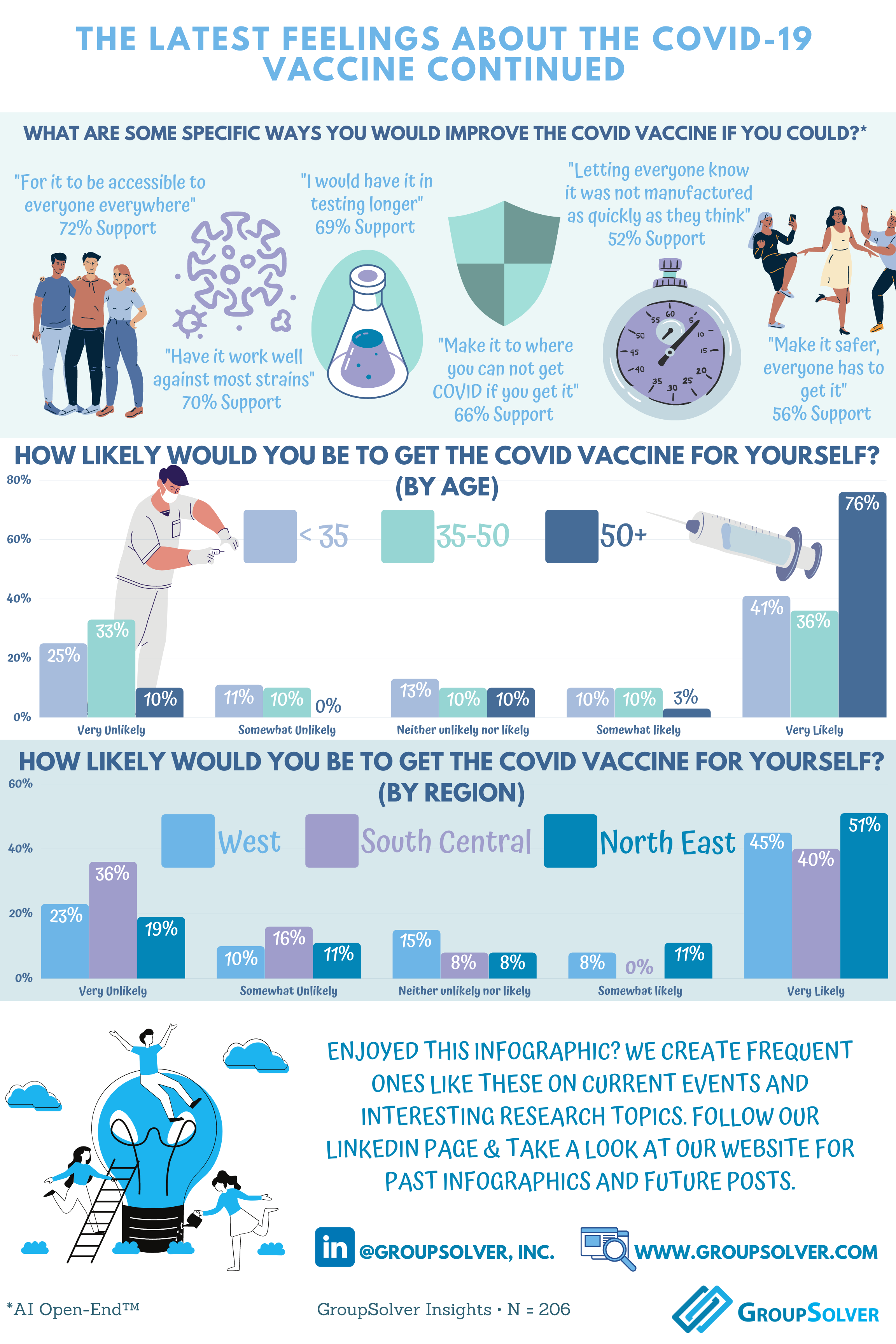
Despite these differing opinions, 45% of respondents say that they are very likely to get the COVID vaccine. The likelihood of these individuals getting the vaccine varies based upon their age and region of the United States. 76% of respondents over the age of 50 are very likely to get their vaccine, while only 36% of respondents ages 35-50 are very likely to get the vaccine. Compared to the West and North East regions, the South Central region is the least likely to get vaccinated, as 36% of respondents from this area say that getting vaccinated is very unlikely for them.
Discover the rest of our insights in the infographic below:

N= 206
Originally published at groupsolver.com
PEOPLE ALSO READ
Book a 30-minute demo with our research team. No deck, no pitch — just the platform answering your questions.
Book a 30-min demoNo credit card · we reply in 24h