Enter a new player: Kamala Harris
**First the usual disclaimer: As it is the case with all our pulse check surveys, these studies are not meant to statistically represent US voting population. Our pulse checks focus on taking a quick temperature read of what is going on with likely voters.
Following the national conversation since the Biden to Harris switch, there is a discernible excitement in the Democratic ranks after a period of nervousness fueled by uncertainty of Joe Biden’s ability to complete his second run for the president. While the energy is high and national polls have already shown a small bump for the new Democratic candidate, it is far from clear that this change alone is enough to change the balance of the race.
Yes, entering Harris on the ticket gives Democrats a small bump…
This is hardly unexpected, and we see it in our data as well: Harris appears to move some likely voters toward the Democratic ticket. The Republican-aligned voters are still more tightly lined up behind Trump (87% would vote for Trump) than Democrat-aligned likely voters (83%), however, the differences are small, and they continue to confirm that both parties are strongly following their party lines.
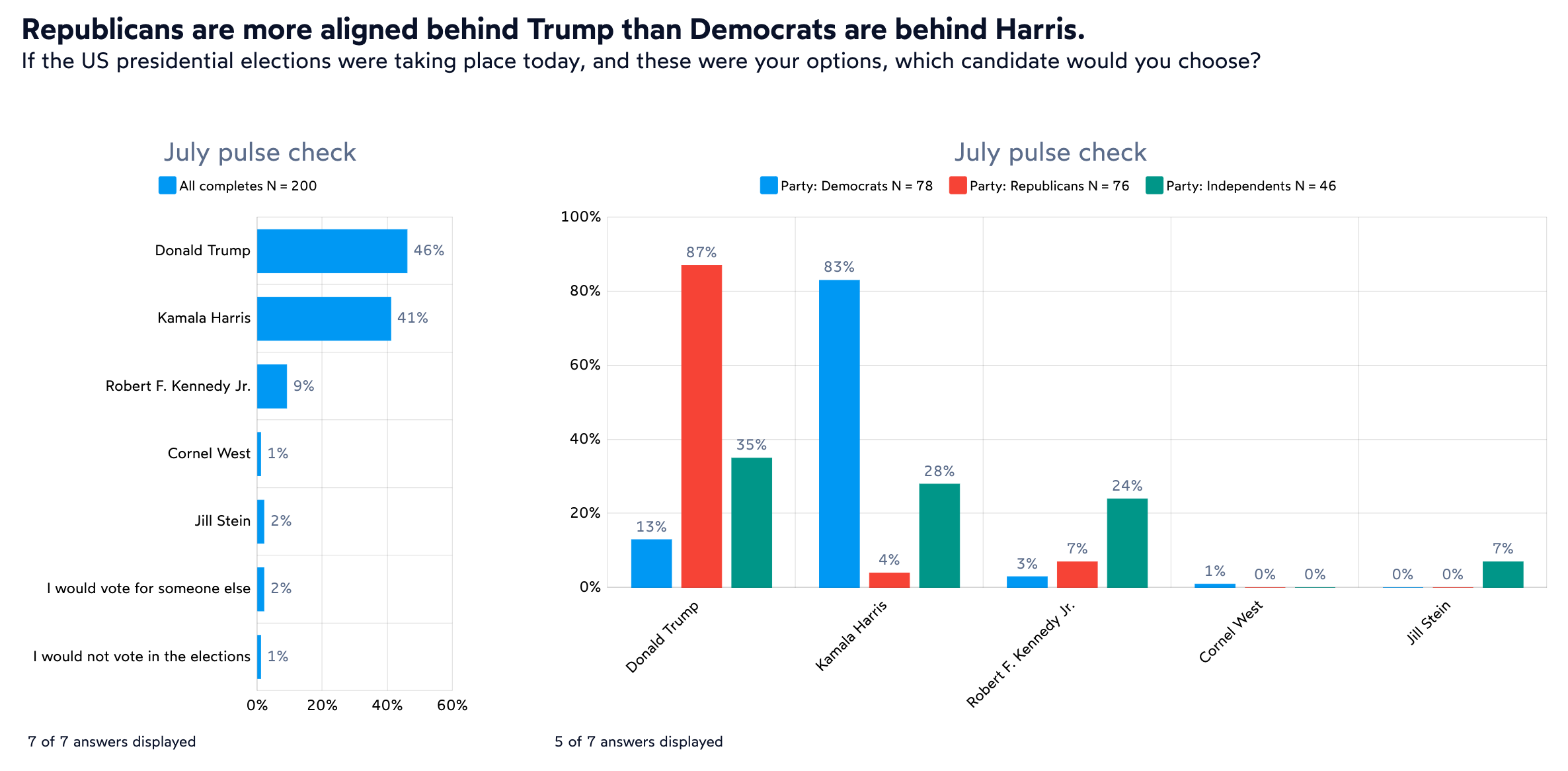
Answering our direct question about how their expected vote has changed since Harris announcement, we see small movement to and from the two major party candidates. Net effect is a small pickup by Harris (+3%) and small loss by Trump (-2%).
We should note that some voters who were planning on voting for Biden are not lining up behind Harris, at least not yet. Some explain their hesitation with Harris being an unknown/unproven entity to them. Others say that both Biden and Trump have been presidents before, and they value experience of running the country enough to give them a pause.
As we have seen in our previous pulse checks, the race is still likely coming down to the decisions of the independent voters **, who are still often undecided. As the list of presidential candidates consolidates toward its final form, a third of the independent vote is currently going toward RFK Jr. and Jill Stein, which is a rather stable number since we have started checking in on independent likely voters.
… but it is still about the economy, and Harris is not convincing the voters that she has a good handle of it (yet)
The economy continues to be top of mind for ALL voters, including independents. But independents are less concerned about social issues, foreign policy and supporting democracy than other voters. One danger that Harris faces if she continues to emphasize her strength on issues like women’s reproductive rights, promoting equity and justice or saving democracy is that she may not be doing enough to move the “meat and potatoes” independents.
Diving a bit deeper into the economy, we asked our respondents which of the two candidates they believe will do a good job on issues such as inflation, unemployment, interest rates and unemployment. Independent likely voters are not seeing her ability to be effective on those issues as much as they see it in former president Trump. Comparing answers to the same question we asked in April when Joe Biden was on the Democratic ticket, we see that independents trusted Biden on the economy more than they trust Harris. That is probably the biggest challenge for Harris to overcome if she is to win the independent vote and likely the November elections.
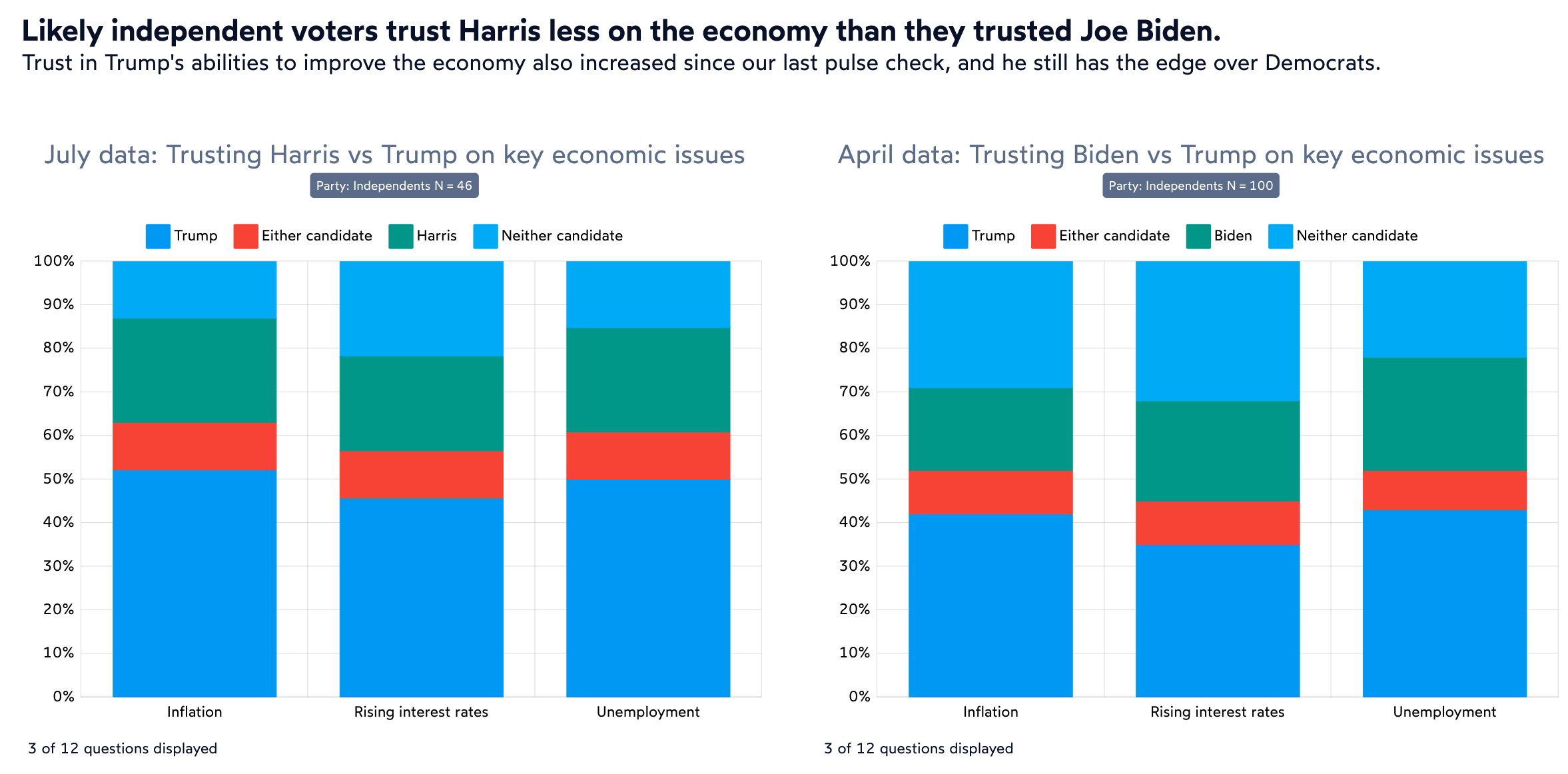
With that said, independents see her as more effective than Trump on equality, equity and climate change, but those issues don’t matter that much to independent voters. Regardless of how we cut the data, we continue to see the same picture for Harris. Those who are less concerned about employment opportunities and living expenses are more likely to choose her as her candidate. Similarly, Harris voters are less concerned about immigration and more concerned about climate change, women’s reproductive rights and other social issues as important to them.
Independents are still in play for November for both candidates
Our data continues to show that independents are less likely (even than Republican likely voters) to be skeptical about inflation trends, which underscores their concerns about the economy and about high prices in particular. More important than unemployment or high interest rates, high prices appear to be the lynchpin issue on which the November election can turn for the independents and for the nation. Which candidate tells a more compelling story on inflation and what the economy will be like between now and December are the two factors to keep an eye on for the next three months. We will continue to keep our finger on the pulse of the independent voter as the picture of the US economy becomes clear. Will either campaign break through with their message on the economy to the skeptical independents? Stay tuned and be among the first to find out!