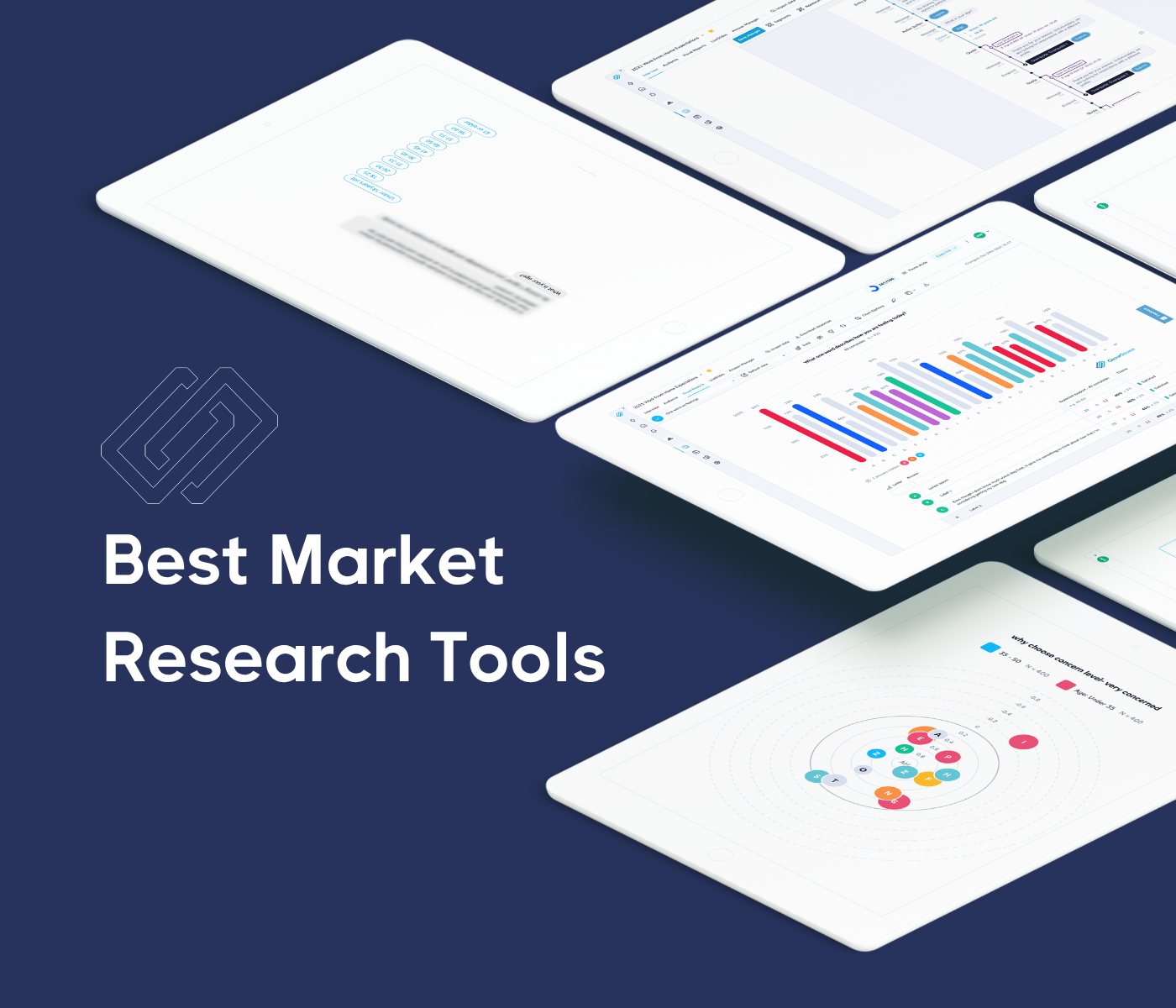
Market research tools help businesses understand customers, validate ideas, and make smarter decisions with confidence. The best market research tools today go beyond simple surveys — they combine AI, automation, and real consumer feedback to uncover not just what people think, but why they think it.
Bravery is essential in business, but there’s a difference between being brave and being reckless. No matter how brilliant and in-demand you believe your business, product, or service is, it’s never wise to jump into the market blindly or to sink thousands into development costs before you have a grasp on the potential.
Fortunately, there are plenty of tools out there to help you get the information you need about your market, your consumers, and your competitors so you don’t have to take a blind leap. It’s just a matter of gathering and using the best market research tools to empower your business.
Short on time? Jump straight to the specific section:
Market research tools are platforms and technologies
that help companies collect, analyze, and interpret data about customers, competitors, and market trends. They typically include:
Survey platforms to collect structured feedback
AI market research tools to analyze open-ended responses at scale
Consumer research platforms with access to target audiences
Analytics tools that turn raw data into actionable insights
Modern tools increasingly blend qualitative and quantitative research, allowing teams to understand both measurable trends and the deeper motivations behind them.
Want to see how modern research tools uncover real customer thinking?
Market research
tools directly impact how confidently and quickly companies can make decisions.
1. Reduce decision risk
Launching without validation is expensive. Research tools help test ideas early and avoid costly missteps.
2. Understand the “why” behind customer behavior
Structured surveys can only go so far. The real value comes from uncovering motivations, perceptions, and unmet needs. This is where modern platforms stand out — by combining qualitative and quantitative methods to clarify the story behind the data.
3. Increase speed to insight
Teams no longer have weeks to wait for results. Today’s tools deliver insights quickly enough to support agile product
and marketing decisions.
4. Scale customer understanding
Instead of relying on small samples, companies can now gather insights from large, diverse audiences without losing depth.
Curious what your customers are really thinking — and what you might be missing?
Some platforms include built-in panels, while others require your own audience.
5. Build a complementary tool stack
Most high-performing teams use multiple tools:
One for deep insight
One for scale
One for fast validation
Top market research tools
1. GroupSolver
When you want specific insights on your product or service, or if there is specific information you need to know about your potential consumers
, GroupSolver is the way to go.
GroupSolver is an intelligent research platform that helps businesses ease the stress of research and data analysis by seamlessly providing clarity. It combines AI-driven technology with robust quantitative methodologies to help you uncover the “why” behind customer behavior. This tool uncovers deep insights using open-ended questions so users can give you their genuine thoughts and impressions without the limitations of a multiple-choice layout. Then, respondents evaluate and rank peer-generated answers — turning qualitative input into structured, quantifiable data.
The result is authentic, comprehensive insight that reflects the true voice of the customer — similar to focus groups, but at scale and with far greater speed.
Why it stands out today:
AI-powered open-ended analysis
Built for both qualitative depth and quantitative validation
Designed to uncover the story behind the data — not just surface metrics
Agatha: autonomous AI research partner that designs, fields, analyses, and delivers decision-ready stories from surveys in hours, not weeks, so you can act on deep customer “why” faster than ever
2. Qualtrics
Qualtrics is a leading enterprise-grade platform designed for experience management and large-scale research programs. Its ecosystem includes specialized solutions for customer, product, and brand research
, making it a comprehensive option for organizations managing multiple research streams.
Strengths:
Advanced customization and logic
Enterprise-level analytics
End-to-end research workflows
Consideration: it’s powerful — but often complex and resource-intensive for smaller teams.
3. SurveyMonkey (Momentive)
SurveyMonkey is one of the most widely used survey tools and remains a go-to option for quick, structured research
. It offers templates, customization, and multilingual capabilities, making it easy to launch surveys quickly.
Where it fits:
Fast feedback collection
Simple use cases
Early-stage validation
Limitation: primarily focused on structured responses, which can limit depth of insight.
4. Ask Your Target Market (AYTM)
AYTM combines survey creation with access to a large respondent panel, making it a flexible consumer research platform. It allows teams to target specific demographics and quickly gather feedback.
Strengths:
Built-in audience access
Easy-to-use interface
Flexible targeting
Limitation: insights may remain more surface-level without deeper qualitative analysis.
5. Quantilope
Quantilope focuses on automating advanced quantitative research methods, helping teams run studies more efficiently.
Key capabilities:
Automated research workflows
Global audience reach
Advanced analytics
Consideration: best suited for structured research; less focused on extracting meaning from open-ended feedback.
Ready to build a research approach that actually explains the "why" behind customer behavior?
Problem: you miss the real motivations behind responses. Fix: include open-ended questions and AI-driven analysis.
2. Choosing tools based on popularity
Problem: misalignment with your actual research needs. Fix: select tools based on use case, not brand recognition.
3. Ignoring qualitative insights
Problem: you understand what is happening, but not why. Fix: combine qualitative exploration with quantitative validation.
4. Treating research as a one-time task
Problem: insights quickly become outdated. Fix: build continuous research into your workflow.
Key takeaways
The best market research tools combine speed, scale, and depth
AI market research tools are transforming how companies analyze open-ended feedback
Consumer research platforms vary — each serves a different purpose
Combining tools delivers better results than relying on one
Understanding the “why” behind customer behavior is a competitive advantage
FAQ
Market research tools help businesses collect and analyze data about customers, competitors, and market trends. They are commonly used for concept testing, brand tracking, and customer experience analysis, enabling more informed decision-making.
AI market research tools process large volumes of qualitative data, identifying themes, sentiment, and patterns. This allows teams to extract deeper insights from open-ended responses and uncover motivations that traditional surveys often miss.
Traditional survey tools focus on structured data collection, while AI tools analyze unstructured responses to uncover deeper insights. The combination of both provides a more complete understanding of customer behavior.
Consumer research platforms either connect you with a panel of respondents or help you manage your own audience. They enable targeted data collection and often include tools for survey design, analysis, and reporting.
Companies should use multiple tools when they need different types of insights — such as deep qualitative understanding, large-scale validation, and ongoing tracking. A combined approach typically delivers more reliable and actionable results.
Want to move beyond guesswork and start making confident, insight-driven decisions?
The landscape of market research tools has evolved from simple survey platforms to intelligent systems that uncover deeper customer insight. Today, the real advantage comes from understanding not just what customers say — but why they say it. If your current research setup isn’t delivering that level of clarity, it may be time to rethink your approach. To explore how you can uncover richer insights and make more confident decisions, visit GroupSolver or schedule a demo call
with our team.