The real promise of AI in market research is NOT voice impersonation. It is much simpler and much less spooky.
**
Disclaimer: While this story talks about politics, it is not our intention to endorse any candidate or any party. We think of it as a case study on the promise of AI technology in market research and how it can enhance customer outreach and conversion.
The 2020 election was decided by less than 50,000 votes, and the 2024 contest is on track to be as close if not closer. With such tight projection, any edge the candidates can find has the potential to swing the few thousand voters in the handful of states to win the race.
As this presidential election year started to roll along, it didn’t take more than a few minutes—and not much forecasting genius—to confirm that the outcome will likely come down to which candidate tells the more _believable _and more _exciting _story of the US economy. Furthermore, with both Democrats and Republicans clearly aligning behind their respective candidates, the result of this election will come down to winning the independent voter. In its simplest terms, to win the independent voter, a candidate needs to achieve two goals: First , understand what story the voter wants to hear and believe. Second , reach the undecided voter **with that story _early _and often until they cast their ballot.
The promise of AI technology, Part 1: Knowing what moves your customer to buy.
It doesn’t matter if we shop for a car or vote for the President. In our heads, there is already a winning answer to the question “why should I buy what you are selling?" It’s just a matter of playing that answer back to the customer to win the deal.
For example, when I bought my most recent family vehicle, I knew that we wanted to get an electric car capable of going 300 miles on a charge that could fit the family… and whose name doesn’t begin with “Tes” and ends with “la”. The first car dealer who told me that story got my business. In the context of the 2024 presidential election, the first challenge for a presidential candidate to earn the independent vote is to discover the story that the independent voters want to hear.
Using our AI Open-Ended™ technology, we invited a panel of 100 independent likely voters to crowd source winning stories for both major presidential candidates. You can find them here
. The stories they co-created with an AI assist make sense, they are on brand, and they address main voters’ concern (no spoiler here: it’s ALL about the economy): Trump should emphasize how great the economy was during his tenure. Biden should showcase his compassion with the middle class while vowing to continue to improve what is already a great economy.
It is worth mentioning that the role of our AI engine was not to put anything into respondents’ mouths. We don’t use the _‘generative’ _part of the large language models. Instead, we use AI to help us sift through many individually human-created ideas, organize them, and pick those that best reflect the consensus of the group.
Our panel of independent voters essentially explained to the presidential candidates what those voters wanted to hear to extend their support for them. With that cheat sheet in hand, all the candidate needs to do is to play it back to them… assuming the candidate can find them. And here lies the second promise of AI in market research.
The promise of AI technology, Part 2: Find the specific customers who want to hear your story.
Having the winning story in hand is the first half of the battle. The second half is getting that story in front of the audience that will make the difference.
It goes without saying that blasting out marketing campaigns indiscriminately is a great way to burn through cash. In the case of the 2024 Presidential campaign, targeting about 500,000 to 1 million likely but undecided voters and the media they visit is probably a better way to spend campaign funds than running adds on every primetime show. Chances are that somewhere in that group are the 50,000 voters who can be persuaded to swing the elections.
Going back to our panel of 100 independent likely voters, we asked ourselves what would happen if we took that small sample and looked for their lookalikes in the general US population. Could we find them? Can we identify anything specific about their online behavior that could help us reach them more efficiently?
We reached out to our partner RevOptimal
with this question, and they ran their lookalike model to see how many individuals meeting our criteria they could find. We were aware that our small study didn’t quite have the amount data to allow us to build lookalikes with a great degree of fidelity, but we gave it a shot. Setting our confidence level at 95%, our friends at RevOptimal identified about 200,000 individuals that match our independent voter profile. An intelligent matching search not only told us who those 200,000 individuals were, but we can also tell what media they are consuming, what websites they visit, etc. That information is invaluable to a presidential campaign.
What we found was that the independent voters differ in meaningful ways from the general population. To understand the differences, RevOptimal built a group of our independent voter lookalikes mirroring the respondents we talked to in our survey and a control group of mainstream general population to highlight the differences between them. Through this enhanced dataset, the analysis explored the overall media consumption habits of independent voters versus the general population, the ideological leanings of the news sources they frequent, their content preferences related to presidential candidates, and their engagement with various political issues.
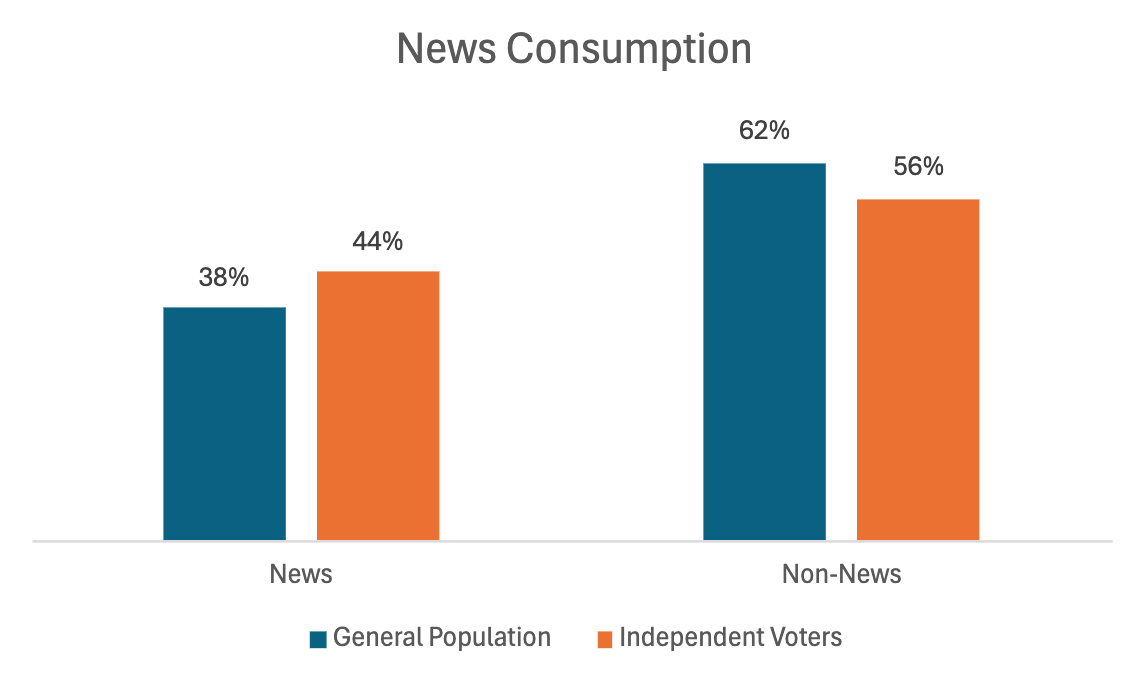
Our analysis of media consumption reveals significant differences in how independent voters engage with political news, necessitating more targeted campaign strategies. For example, we found that independent voters consumed more news content(44% of all content consumer is news-related) relative to the general population (38%). This difference is not large in our sample, but we should note that our quick pulse check study didn’t generate as many anchor points for the analysis as it typically would in a full-scale survey.
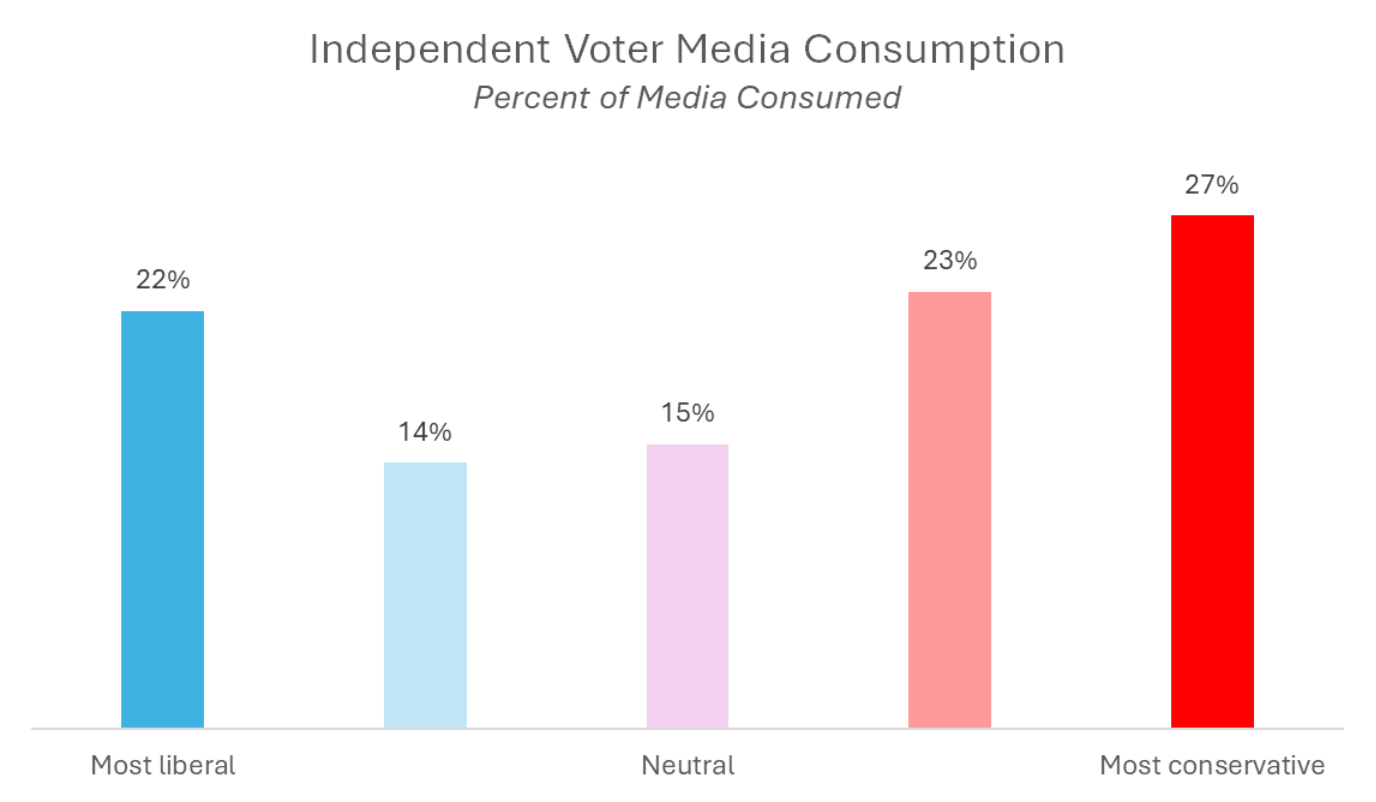
 Another interesting insight from the lookalike analysis is that this group of undecided independent voters consumes more media
from conservative-leaning sources. This is important information for campaigns allocating their resources to reach the most valuable voters. With 70%+ of media consumption coming from conservative or the most liberal-leaning sources, it would make sense to allocate the greatest share of the marketing dollars there.
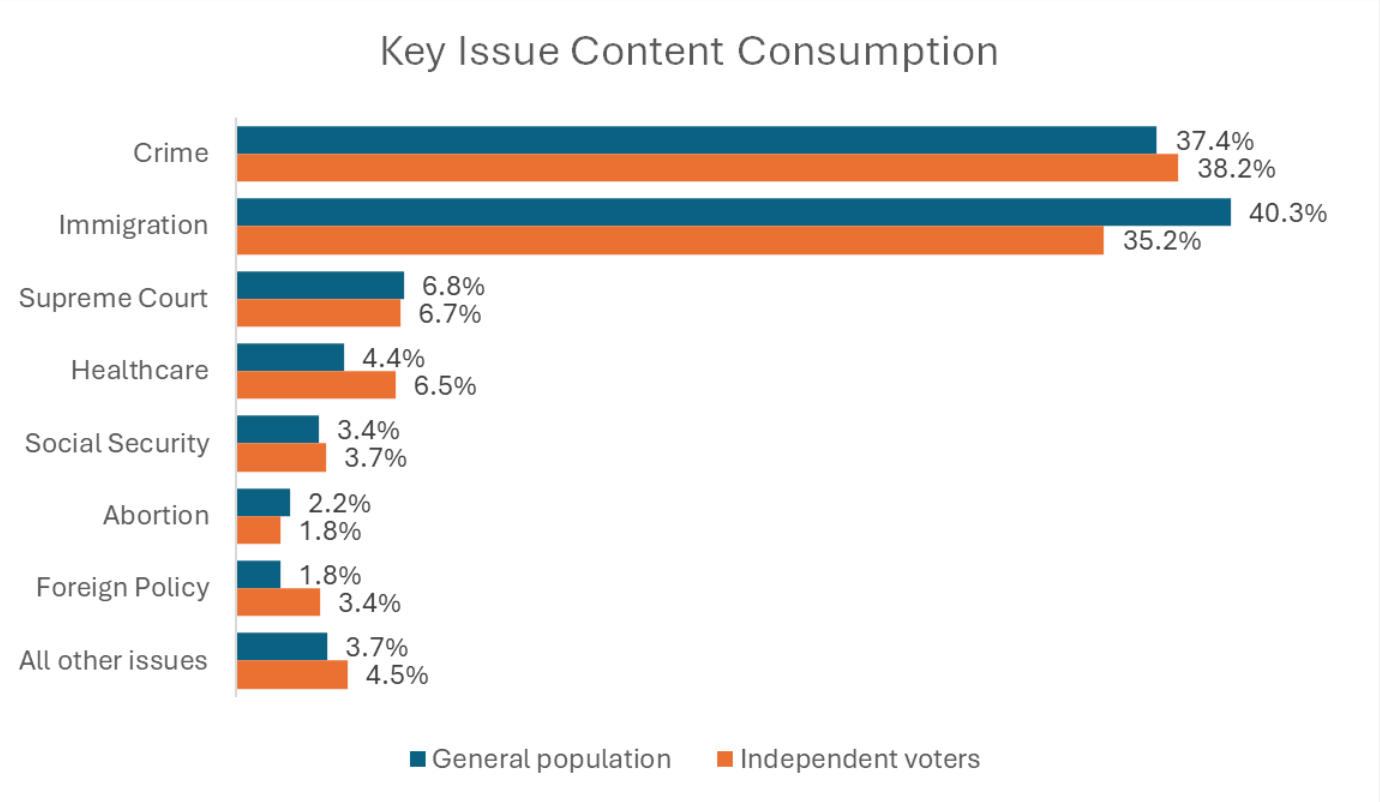
Finally, our analysis of 200,000 independent voter lookalikes took a quick look at the type of political content consumed by the independent voters versus the general public. The greatest difference that stood out from the data – and this was no surprise to use given that this theme has come up in every pulse check we have run this year – the independent voters care less about immigration issues than their general population counterparts and more about healthcare or foreign policy.
Putting it all together.
Combining the two AI aided technologies can make a real, measurable difference on a presidential campaign or on a new product introduction. These two AI applications may not be the most futuristic stretching our imagination. They are not making outrageously transformative claims promising to replace human market researchers or respondents with AI avatars – more on that topic another day. But what those technologies are already here and what they do is to connect the dots on the journey marketer’s take every day: taking the signals in the voice of the customer and then picking up those signals when sending out targeted campaigns. The AI-assisted future is here now, and we may have not even noticed…