Gen Z consumer insights: What they cut, what they splurge on, and why they still believe in the future
·10 min read
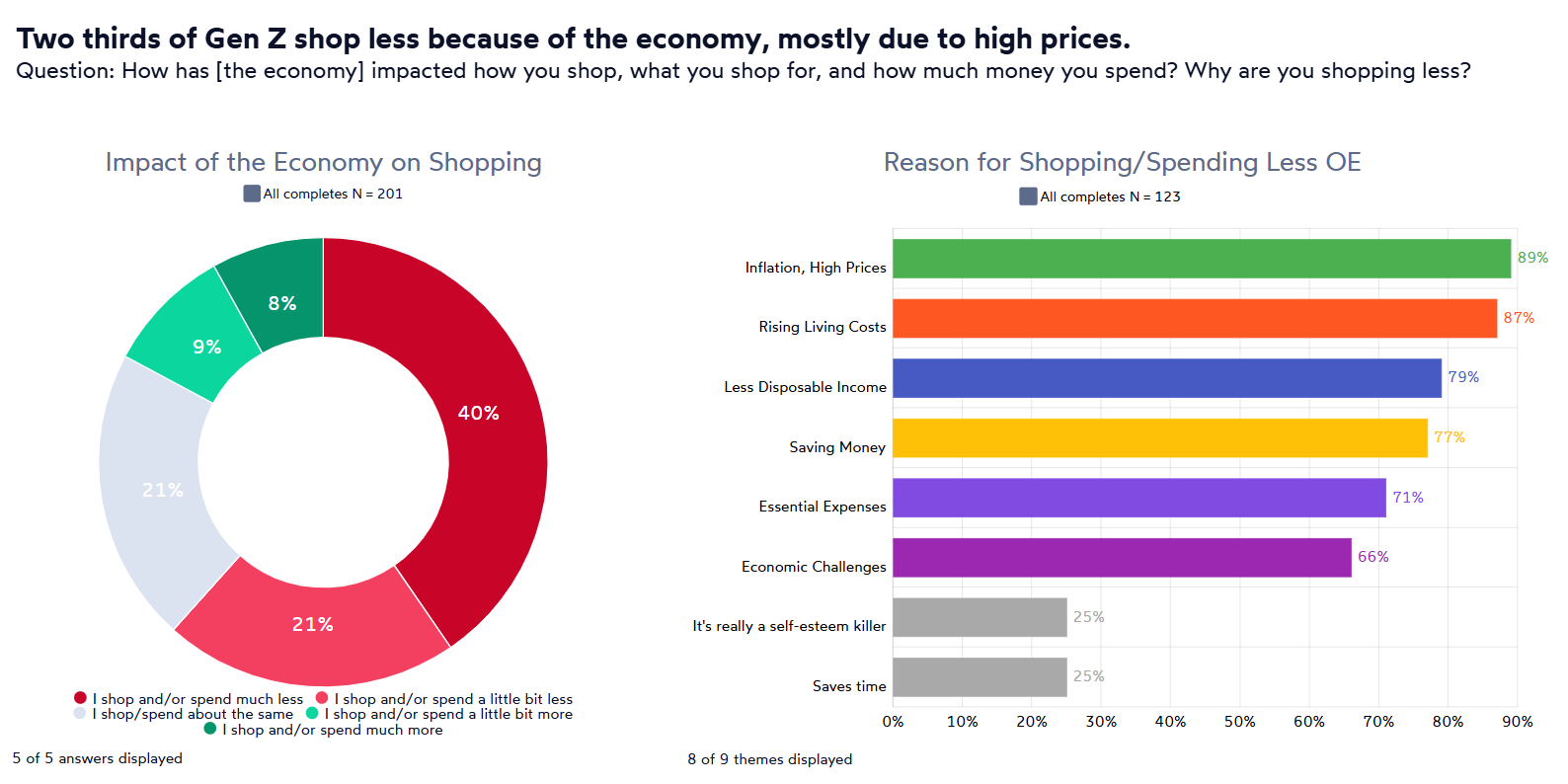
The most useful Gen Z consumer insights of 2026 start with a contradiction: this generation feels financially squeezed right now, yet stays remarkably optimistic about what comes next. In a GroupSolver study of more than 200 quality-screened Gen Z shoppers, 61% said they’re spending less and most rate the economy poorly — but 60% are excited about the next three to five years and roughly three-quarters believe their long-term goals are attainable. What they cut, what they still splurge on, and where that optimism comes from tells brands far more than any single spending headline.
Short on time? Jump straight to the specific section:
Gen Z consumer insights are the patterns in how this generation feels, spends, and decides — not just the topline numbers, but the reasoning behind them. Good insights explain why an 18-to-28-year-old cuts one category and protects another, not only that they did.
The headline pattern this year is tension. Gen Z is under real pressure, and they know it:
62% rate the economy “poor” or “terrible” for themselves personally.
69% say their feelings about the economy have worsened over the past 12 months.
55% expect it to get worse still in the year ahead; fewer than one in five expect improvement.
61% say they are spending less than they used to.
That squeeze isn’t a Gen Z quirk. It tracks with the broader market — McKinsey’s US consumer research, for example, found Gen Z reporting sharply higher unemployment anxiety and pulling back across discretionary categories. But here’s the part the syndicated trackers rarely capture: the same young people who describe the economy as “terrible” are, in the next breath, optimistic. Six in ten are excited about the next three to five years, and about three-quarters believe their long-term goals are within reach. Reading Gen Z well means holding both of those truths at once — and that’s exactly what the rest of the data helps explain.
Ready to see how AI reads real human voices at scale?
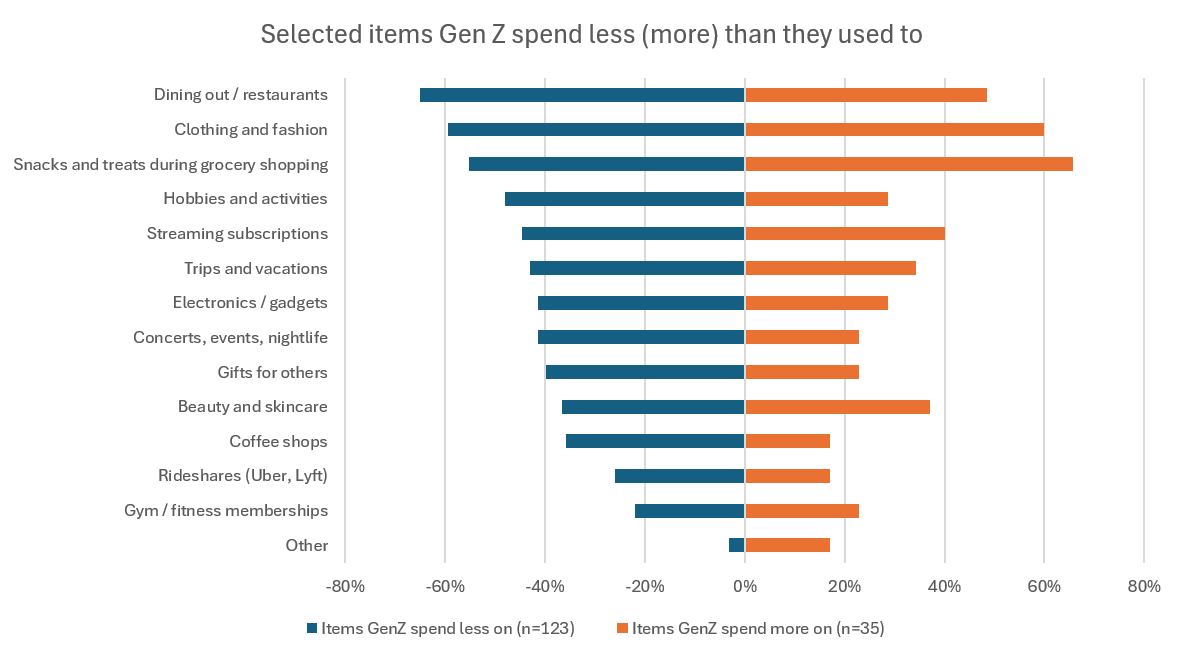
The clearest window into Gen Z spending habits is watching what disappears from the cart first. Among those cutting back, the order is consistent:
Dining out (65%) is the first thing to go
Clothing and fashion (59%)
Snacks and treats (55%)
What stays? The commitments that are hard to unwind. Gym memberships (22%) and rideshares (26%) were the least likely to be cut — the fixed routines and the get-to-work essentials survive the squeeze.
Now the counterintuitive part. Look at the minority who say they’re spending more, and the top three categories are almost identical: snacks (66%), fashion (60%), and dining out (49%). That group is small and directional rather than statistically representative — but the pattern is too clean to ignore.
So the exact categories Gen Z cuts first are also the ones they splurge on first. These aren’t fickle choices, they’re the affordable joys. Dining, fashion, and a treat at the register are the levers this generation pulls in both directions to feel a sense of control over a budget that otherwise feels out of their hands. For brands, that makes these categories the most volatile line in the Gen Z budget: first to contract, first to bounce back, and highly responsive to how the wider economy is moving. Notably, most of the “spending more” isn’t discretionary at all — much of it is simply the rising cost of essentials, a squeeze even the spenders can’t escape. It echoes what Deloitte’s retail research has documented at the household level: value-seeking behavior and belt-tightening hitting younger shoppers hardest.
Where Gen Z’s optimism actually comes from
If Gen Z feels this squeezed, where does the optimism come from? Their aspirations split cleanly by time horizon. For the next three to five years, the goals are pragmatic and defensive: build a career, reach financial stability, and, for many, own a home. The softer stuff — personal fulfilment and happiness — is the long-term prize, set aside for now while they get their footing. Squeezed today, building for later.
But the most striking finding came from an open-ended question — no answer options, just a blank text box — asking what makes them hopeful about the economy over the next few years. The single largest theme had almost nothing to do with their own finances. It was political change.
Roughly one in three answers named it directly: a change in administration, new leadership, the next election. Group the closely related phrasings the way an AI reads meaning rather than keywords, and it becomes the dominant theme by a wide margin — approaching half of all hopeful responses. No personal factor like a raise, a new job, or a growing savings account came close. That’s a meaningful signal about how this generation frames its economic future: not as something they’ll fix transaction by transaction, but as something tied to forces larger than themselves. It also says something about how Gen Z relates to institutions and the wider world — a lens most brand trackers never think to open, because a multiple-choice grid can’t surface an answer nobody thought to pre-write.
How much of your survey data would survive a quality screen?
Read together, these findings carry three implications that should change how brands plan.
Budgets are emotional, not just rational. The affordable-joy categories (snacks, fashion, dining) are where Gen Z spends to feel human when everything else feels tight. A brand in one of these categories isn’t competing on price alone; it’s competing to be the small reward worth keeping. Frame the product as a manageable treat, not a splurge, and it survives the cut.
Volatile categories reward brands that show up early. Because these categories contract and rebound fastest, the brand Gen Z reaches for on the way down is the one they scale up with on the way back. Winning a modest, frequent purchase now is a claim on a much larger share later.
Loyalty is deep, but you have to earn the entry. In the study, 58% of Gen Z said they have a go-to favorite brand, and of those, roughly 95% said they trust it. When this generation commits, the commitment runs deep. The catch is that commitment is earned, not assumed, which is why measuring brand perception
and the specific drivers of Gen Z brand loyalty matters more than tracking awareness. The generation that will defend your brand is the same one quietly deciding, right now, whether you’re worth defending.
Curious whether Gen Z trusts your brand — or just knows it?
None of the findings above hold up if the underlying data is soft. Gen Z is the hardest generation to survey cleanly — fast, mobile, and increasingly sharing panels with AI-generated “respondents.” Here’s how to get insights you’d actually stake a decision on.
Screen for real humans before you believe a single number. The 200+ completes behind this study passed multiple attention and logic traps designed to catch bots, speeders, and inattentive respondents. Skip that step and you’re modeling noise. This is the exact failure mode described in how low-quality panels corrupt research
. Start with the data-quality measures every survey needs
.
Ask open-ended questions, not just scales. The political-change finding was invisible to any multiple-choice grid, and it only appeared because respondents could answer in their own words. Scales tell you how much; open ends tell you why.
Group answers by meaning, not by keyword. Counting exact words undercounts real themes: “vote them out,” “new leadership,” and “different president” are one idea in three costumes. Semantic grouping is what moved that theme from “a third” to the dominant story.
Let AI find the direction, but validate the decision with humans. AI is fast and gets you most of the way, but the last mile — the nuance that changes a strategy — comes from verified human data. That principle sits at the center of GroupSolver’s approach to trustworthy AI in market research
.
Put the raw data in stakeholders’ hands. The fastest way to build trust in an insight is to let people interrogate it themselves. GroupSolver’s AI analyst, Agatha, does exactly this: ask any question of this Gen Z dataset and get an answer grounded in real human voices, not a generic guess.
Key takeaways
Gen Z is squeezed but hopeful: 61% are spending less and most rate the economy poorly, yet 60% are excited about the next 3–5 years.
Dining out, fashion, and snacks are cut first, and are also the top categories the minority spending more splurge on, making them the most volatile part of the Gen Z budget.
Gym memberships and rideshares are the last things Gen Z cuts, because routines and get-to-work essentials survive the squeeze.
The biggest source of Gen Z optimism is political change, not personal finances — a theme only an open-ended question could surface.
58% of Gen Z have a favorite brand and ~95% of those trust it: loyalty runs deep, but the entry has to be earned.
Trustworthy Gen Z insights require quality-screened respondents, open-ended questions, and AI reading validated against real human data.
FAQ
Gen Z consumer insights are evidence-based patterns in how people roughly aged 18 to 28 feel, spend, and make decisions. Strong insights go beyond topline numbers to explain the reasoning behind a behavior — why a category gets cut or protected — which is what makes them useful for brand and product strategy.
Among Gen Z consumers who are spending less, dining out is cut first (65%), followed by clothing and fashion (59%) and snacks (55%). Gym memberships and rideshares are cut least, because fixed routines and commute essentials tend to survive an economic squeeze more than discretionary treats do.
Most Gen Z optimism is tied to expected political change rather than personal finances. When asked what makes them hopeful, the largest open-ended theme was a change in administration or leadership. They frame near-term goals defensively — career, stability, home — while reserving fulfillment for the long term.
Loyalty runs deep once earned. In this study, 58% of Gen Z reported having a go-to favorite brand, and roughly 95% of those said they trust it. The challenge for brands is not retention but entry: proving they deserve commitment before Gen Z decides whether the brand is worth defending.
Use quality-screened respondents to filter out bots and inattentive answers, ask open-ended questions to capture the "why," and group responses by meaning rather than keywords. Then let AI accelerate analysis while validating its reading against verified human data before acting on any finding.
The real story in these Gen Z consumer insights isn’t the squeeze or the optimism on its own, it’s that both are true at once, and that the reasons only surface when you ask the right way. Gen Z will cut the dinner out and keep the gym, describe the economy as terrible and still bet on their own future, and pin their hope on forces bigger than their bank balance. Brands that read those signals with quality-screened, human-validated data won’t just track what this generation is doing — they’ll understand why, early enough to act on it.
The dataset behind this article is open for you to explore. We loaded all 200+ human-validated Gen Z responses into an interactive demo
where you can ask this dataset your own questions: about their favorite brands, how their shopping has shifted, or what they’re hoping for next, and watch a generic AI answer transform once it’s grounded in real human voices.
Want to ask your own questions of this Gen Z dataset?
This article expands on ideas originally shared by GroupSolver CEO Rasto Ivanic in a LinkedIn article
about what Gen Z cuts, what they splurge on, and why they still believe in the future.