How many times have you walked to your local coffee shop, sat at your airport gate, or waited on the grocery store check-out line and people-watched everyone around you living different lives? How often have you wondered: What’s their story? Where did they come from? We are said to be the land of the free because people can be who they want to be here—achieve the American Dream.
But when it comes to immigration at our Southern borders, does that dream suddenly seem even more distant? Or perhaps it is more sacred and saved for certain people? And even more interesting—are we still a country of immigrants? Maybe this is a topic where we start to disagree on what that means to come to the U.S. and be an American.
Election season is right around the corner and tensions are extra heightened when it comes to certain issues like immigration, particularly at our Southern borders. In the spirit of staying curious, we wanted to uncover what every-day people—both immigrants and non-immigrants alike—thought about this issue.
So, are we one country indivisible, or are we on separate teams?
Who are we?
When running this pulse-check study, we determined that to uncover a deeper layer behind the border immigration issue would be by surveying both English and Spanish speakers—and beyond that, those who were born in the U.S. versus those born outside of the country. Our English sample comprised of 102 respondents, of which 95% are citizens. On the flipside, our Spanish sample has 86 respondents and included 70% immigrants primarily from Cuba (22%), Mexico (13%), and Venezuela (23%). (Note: this pulse check did not aspire to achieve Census representation)
_
The majority of our Spanish-speaking sample have friends (52%) and family (47%) who have immigrated as well, which can potentially be related to the more positive feelings towards the topic (more to come on that later). A shocking amount of 56% of the English sample did not _know any immigrant personally.
There is also an astounding difference in 44% of Spanish-speakers who agree immigrants should always be allowed regardless of their legal status, compared to 11% of our English-speaking sample. Their reasoning is related to believing it is their right to help their families, work hard, and progress in life.
_
What do we think about immigration and our current policies?
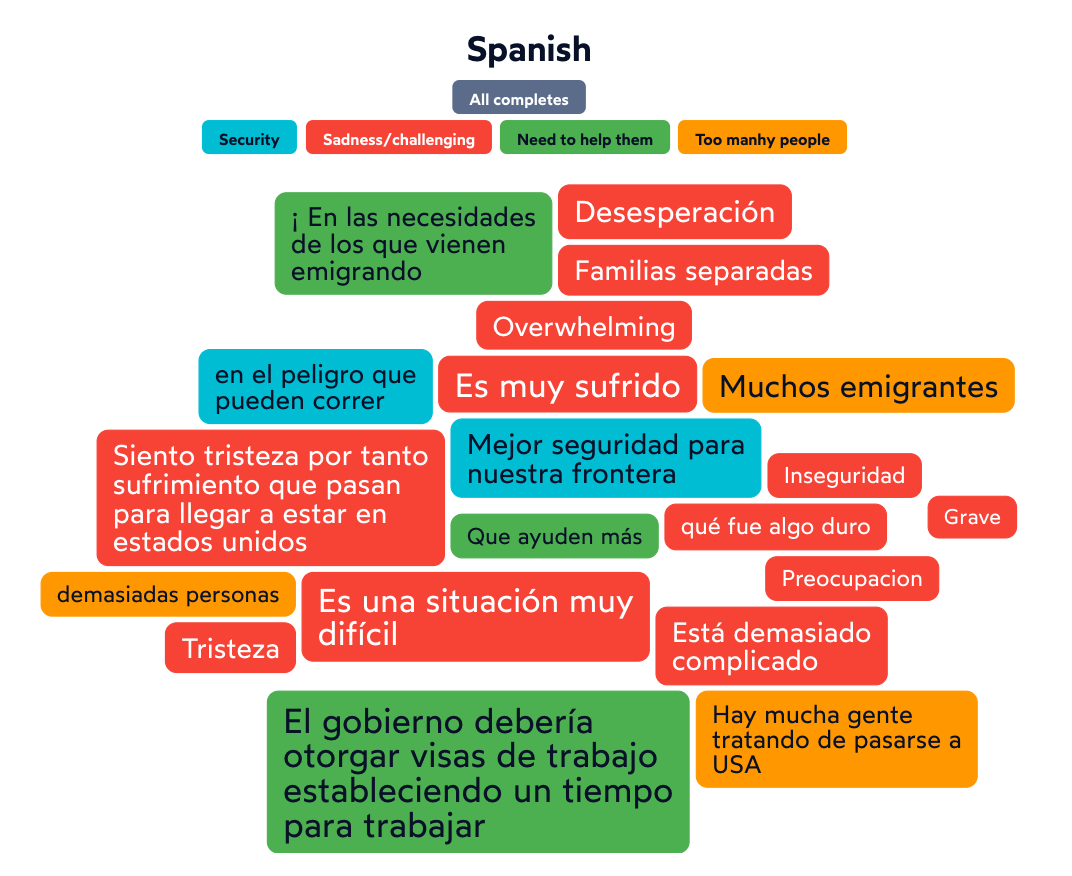
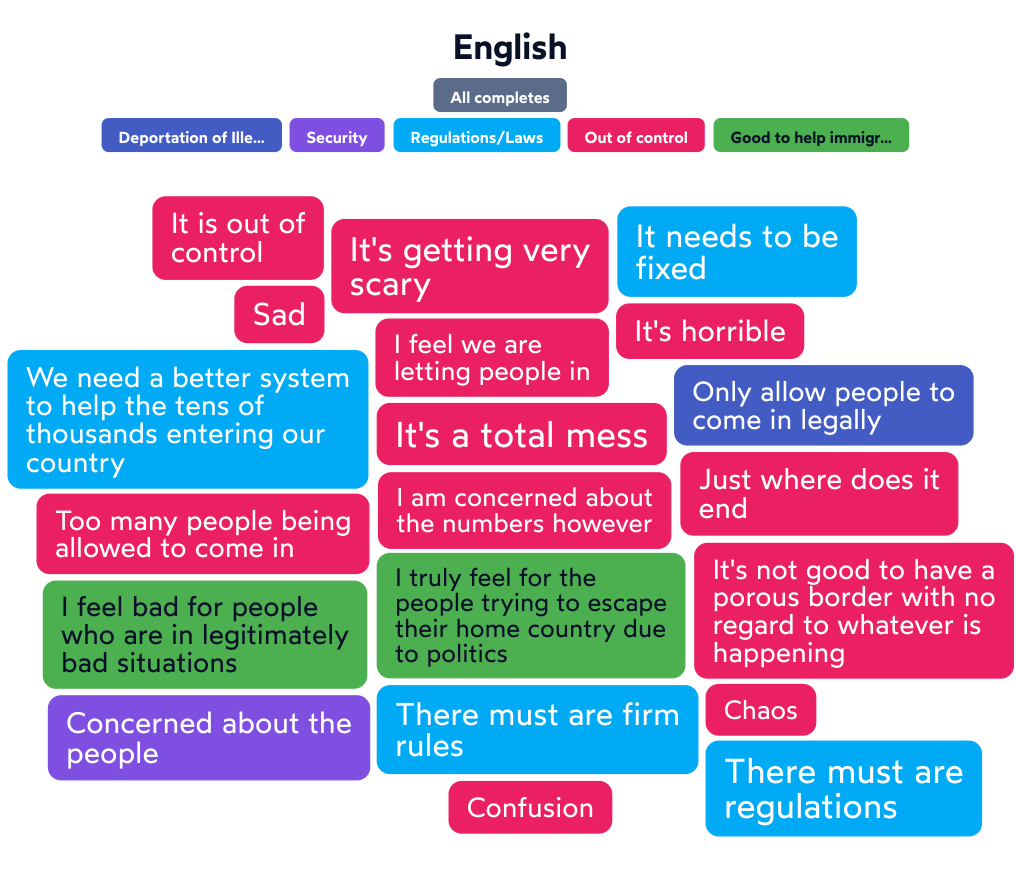
In diving through the numbers, it truly feels like our respondents have almost a binary response to the topic of immigration and immigrants. On the one hand, we hear concerns about the chaotic, overwhelming situation that is out of control and needs to be regulated better,
legally_
.
But on the other hand, we are also hearing concern about people being in “legitimately bad situations” and they welcome them and wish them well. This is especially seen in our Spanish sample consisting more of immigrants themselves.
IdeaCloud™
" data-large-file="/images/blog/Screenshot-2024-04-09-at-12.46.09-PM-1024x837.png" />
IdeaCloud™
IdeaCloud™
" data-large-file="/images/blog/Screenshot-2024-04-09-at-12.47.54-PM.png" />
IdeaCloud™
Predictably, Democrat-leaning respondents tend to be concerned more about the situation immigrants may find themselves in and show more empathy regardless of legality. Republican-leaning people are more focused on justice and enforcing the rules, mainly naming the need to respect the laws of the country.
Bars from left to right: All completes, Democrat sample, Republican sample
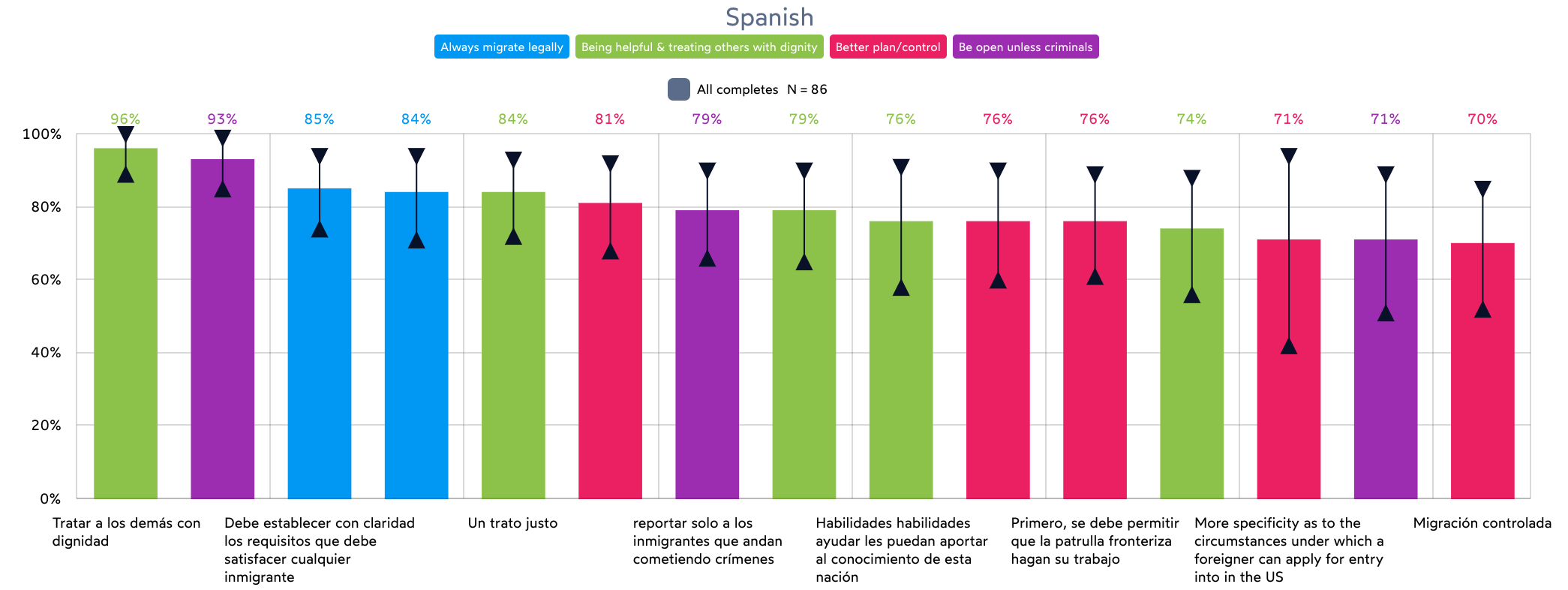
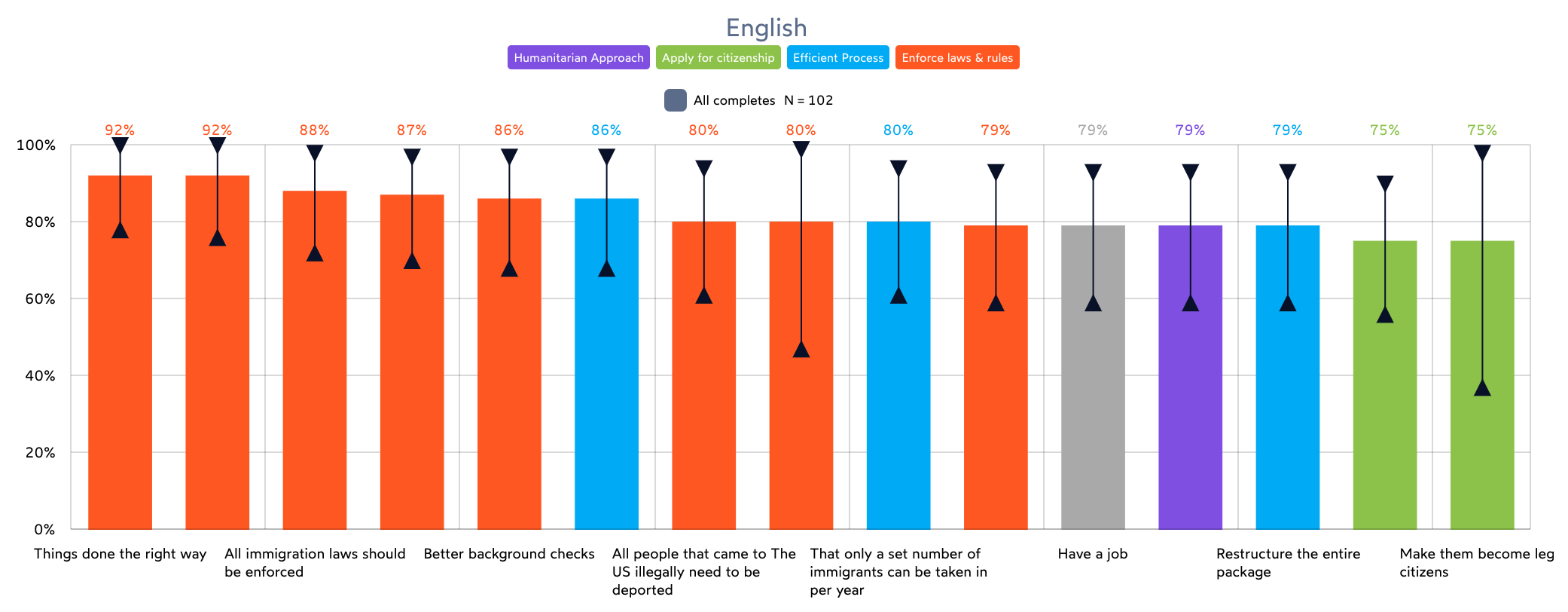
We then asked folks what they would want U.S. immigration policy to include, and by and large, people agreed that the current laws are probably okay, they just need to be enforced better. This especially rings true with our English sample. Our Hispanic sample seems to be more sympathetic and open as long as it doesn’t pose a legal or security risk. Overall, our respondents didn’t provide overly nuanced or novel ideas on how to improve US immigration policies, but that is perhaps to be expected. Immigration may be a topic that is emotionally charged, but the solution (i.e., the laws, policies and enforcement) is a bit beyond what people think about every day.
Where do we stand, as one nation?
Despite the contestations we see on our social media feeds and on the news, it really doesn’t seem like we ALL are overly aggravated about this issue. While there were clear polar differences, there is an overlying theme of just wanting respect for both people coming in and for the laws.
It feels as if where people stand really relates to how personal this issue is to them. Our Spanish speaking sample were more sensitive and compassionate towards immigrants and this topic likely because they immigrated or know people who immigrated personally. Whereas the fact that over half of our English sample did not know of anyone in their circle, it may be harder for them to identify with the or relate to their stories.
Will this topic spike more outrage as we inch closer to the elections? That, ladies and gentlemen, is something we will stay tuned for…